Lesson 6 · 15 min
Mooring equipment and mooring line management
You will be able to run a mooring line management system that meets SOLAS II-1/3-8 and pick a replacement line without overloading the ship's fittings.
Start here
The 2-minute primer
New to this? These 6 cards explain the lesson in plain words. Go through them first and the lesson will make sense.
Primer done.
-
1/6Picture this
The fuse should blow, not the house
In a house, the fuse is the weak point on purpose. If too much power flows, the cheap fuse goes, not the wiring in the walls.
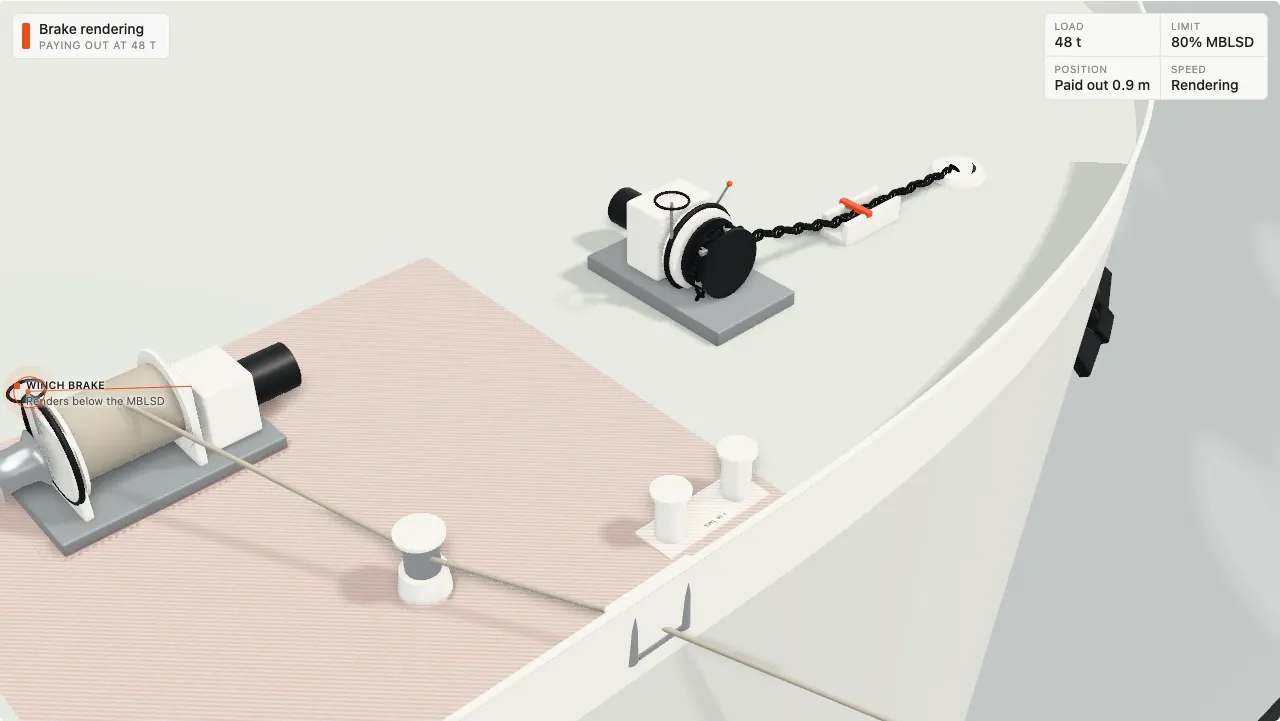
Mooring works the same way. The rope, the winch brake and the posts on deck are matched, so the right thing gives first. A rope that is far too strong moves the weak point somewhere worse.
-
2/6The big idea
Know, inspect and replace your lines in time
Each ship’s deck fittings were designed for ropes of one strength. That strength is written on the ship’s mooring plan.
Good line management means three things: give every line an identity and a history, inspect it and retire it before it fails, and replace it with a line of the right strength. Not weaker, and not much stronger.
-
3/6Words you'll meet
Six words, in plain English
- Mooring line
- a heavy rope that ties the ship to the quay.
- MBLSD
- ship design minimum breaking load, the line strength the ship’s fittings and winches were designed for.
- LDBF
- line design break force, the breaking strength of a new line, which should be 100% to 105% of the MBLSD.
- Fairlead
- a smooth guide on the ship’s edge that the rope runs through on its way ashore.
- Brake rendering
- the winch brake slipping on purpose before the rope is pulled to breaking point.
- Snap-back
- the violent whip of a rope that breaks under load and flies back along its path.
-
4/6Why it matters
A parting line moves faster than people
When a loaded line breaks, it snaps back faster than anyone can step aside. Mooring is one of the most dangerous everyday jobs on deck.
Lines rarely fail without warning. They chafe, age in the sun and get overloaded by brakes set too tight. Checking them, and fitting the right strength, keeps the crew out of harm’s way.
-
5/6In this lesson
What you’ll be able to do
- Find your ship’s design strength on the mooring plan.
- Pick a replacement line that matches the ship’s fittings.
- Inspect lines and retire them before they fail.
- Know why winch brakes should slip before the line breaks.
-
6/6Quick check
The office buys mooring lines much stronger than the design. Is that good?
Right: the fittings were built for one line strength. A much stronger line moves the weak point to the bollard, fairlead or hull.
The basics
When a mooring line parts under load, it recoils along and beyond its own line of tension, faster than anyone can move. Mooring is one of the most dangerous routine jobs on deck, and IMO’s own guidance now asks for every mooring area to be treated as a potential snap-back zone.
Lines rarely fail without warning. They wear, chafe, fuse, age in the sun and are overloaded by brakes set too tight or by fittings that are too weak for them. Since 1 January 2024 SOLAS regulation II-1/3-8 requires every ship, new or old, to inspect and maintain its mooring equipment, including the lines, in a suitable condition, with IMO guidelines that describe how.
Sign in to read the rest of this lesson
Continue reading
Save your progress, open all 115 lessons and get a Course completed card when you finish.
or use your email
In the rest of this lesson
- Try it: The new mooring lines arrive
- In plain words
- In detail
- What the rules say
- Flag and class notes
- Key numbers
- What inspectors find
- 4 questions people ask
- Quiz: 6 questions
- Ask our engineers about this lesson
Familiarisation training from Al Safwan Academy. Finishing a course shows completion of online familiarisation training: it is not an STCW, flag-approved or manufacturer qualification, and these courses don't replace that training. The manufacturer's manual and your flag's rules always come first.