Lesson 4 · 15 min
Wire rope on cranes and derricks – inspection and discard
You will be able to inspect a running wire rope, recognise the discard signs and check that a replacement rope is properly certified.
Start here
The 2-minute primer
New to this? These 6 cards explain the lesson in plain words. Go through them first and the lesson will make sense.
Primer done.
-
1/6Picture this
A rope that frays from the inside
Think of an old garden hose. The outside can look fine while the inside has cracked, and one day it splits under pressure.
A steel wire rope is many thin wires twisted into strands around a core. It can lose strength inside, where nobody looks, while the outside just looks a bit dirty.
-
2/6The big idea
Know the signs, then let it go
A wire rope is built to lose a few wires safely, but only a few. Inspecting it means looking along its whole working length, especially over pulleys, on the drum and at its end fittings.
You look for broken wires, a thinner rope, rust, kinks and heat damage. When the signs pass the limits, the rope is replaced. You never splice two damaged pieces together.
-
3/6Words you'll meet
Six words, in plain English
- Strand
- a bundle of steel wires twisted together; several strands twisted around a core make the rope.
- Discard
- taking a rope out of service for good because it is no longer safe.
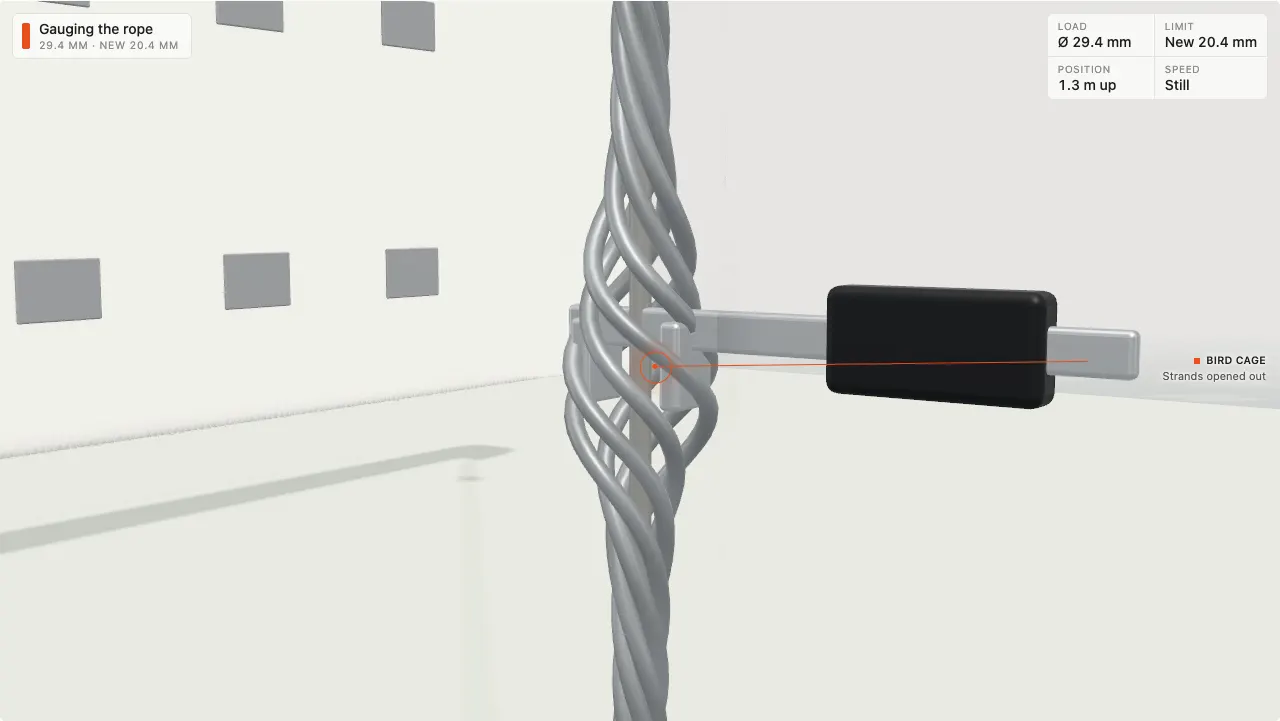
- Bird caging
- strands springing open into a cage shape, a clear sign the rope must go.
- Sheave
- the grooved wheel, like a pulley, that the rope runs over.
- Rope dressing
- a special grease worked into the rope to keep rust out.
- ISO 4309
- the international standard that sets when a crane rope must be discarded.
-
4/6Why it matters
When a rope parts, two things happen
The load falls, and the rope whips back with huge force. Anyone nearby can be badly hurt.
Many failures give warnings first: broken wires, a thinner patch, rust. A crew that knows the signs, and a ship that keeps rope certificates and discard rules on board, can replace the rope in time.
-
5/6In this lesson
What you’ll be able to do
- Inspect a running wire rope along its working length.
- Spot the signs that mean “replace it now”.
- Know why rope on synthetic pulleys can hide damage inside.
- Check that a new rope comes with the right certificate.
-
6/6Quick check
You see a bird cage near the drum end of a hoist rope. What now?
Right: bird caging is one of the clear signs that a rope must be replaced before the crane is used again.
The basics
Wire rope fails from the inside out. Broken wires hide in the valleys between strands, corrosion eats the core where no one can see it, and a rope that looks merely dirty can have lost a large part of its strength. When a hoist rope parts, the load falls and the rope whips back with enormous energy.
That is why both the ILO code of practice and the SOLAS lifting appliance guidelines point to one international standard for the discard decision, ISO 4309, and why certification of the rope itself is one of the items a thorough examination checks. This lesson shows what to look for and when the answer is “replace it now”.
Sign in to read the rest of this lesson
Continue reading
Save your progress, open all 115 lessons and get a Course completed card when you finish.
or use your email
In the rest of this lesson
- Try it: Keep, check or discard?
- In plain words
- In detail
- What the rules say
- Flag and class notes
- Key numbers
- What inspectors find
- 4 questions people ask
- Quiz: 6 questions
- Ask our engineers about this lesson
Familiarisation training from Al Safwan Academy. Finishing a course shows completion of online familiarisation training: it is not an STCW, flag-approved or manufacturer qualification, and these courses don't replace that training. The manufacturer's manual and your flag's rules always come first.