Lesson 7 · 14 min
Gangways and accommodation ladders – inspection, testing and rigging
You will be able to inspect and rig a gangway or accommodation ladder to the revised IMO guidelines and plan its annual and five-yearly survey items.
Start here
The 2-minute primer
New to this? These 6 cards explain the lesson in plain words. Go through them first and the lesson will make sense.
Primer done.
-
1/6Picture this
The front steps everyone uses
Think of the steps up to a busy shop door. Customers, delivery drivers and staff all use them every day. Nobody thinks about them until a step cracks or the handrail wobbles.
A ship’s gangway and accommodation ladder are its front steps. Crew, pilots, agents and visitors all walk over them, often above the water.
-
2/6The big idea
Built right, rigged right, checked often
A gangway is a walkway from the ship to the quay. An accommodation ladder hangs down the ship’s side from a small crane arm and winch.
Both must be built to a standard, rigged at an angle they were designed for, with handrails, a safety net and a lifebuoy nearby. They are checked every time they are rigged, examined every year and load tested every five years.
-
3/6Words you'll meet
Six words, in plain English
- Gangway
- a portable walkway between the ship and the quay.
- Accommodation ladder
- a stairway hung down the ship’s side, raised and lowered by a winch and wire.
- Davit
- the small crane arm that holds the wire supporting the ladder.
- Stanchion
- an upright post that holds the handrail or rope along the side of the ladder.
- Safety net
- a net rigged below and beside the ladder to catch anyone who slips.
- Maximum operational load
- the heaviest load the ladder is marked to carry, set by its last load test.
-
4/6Why it matters
The weak points are ordinary ones
When a gangway collapses or a wire parts, people fall between the ship and the quay, or into the water.
The causes are usually simple: rust where steel fittings meet aluminium, a wire never renewed, a bent post, or a ladder rigged steeper than it was built for. Regular checks catch these before anyone gets hurt.
-
5/6In this lesson
What you’ll be able to do
- Inspect a gangway or accommodation ladder each time it is rigged.
- Rig it at a safe angle with net, lighting and lifebuoy in place.
- Know what the yearly examination and five-yearly load test cover.
- Know when the supporting wire must be renewed.
-
6/6Quick check
The ladder’s wire is just over 5 years old and looks fine. What now?
Right: supporting wires are renewed when worn or after 5 years at most, whichever comes first, even if they look fine.
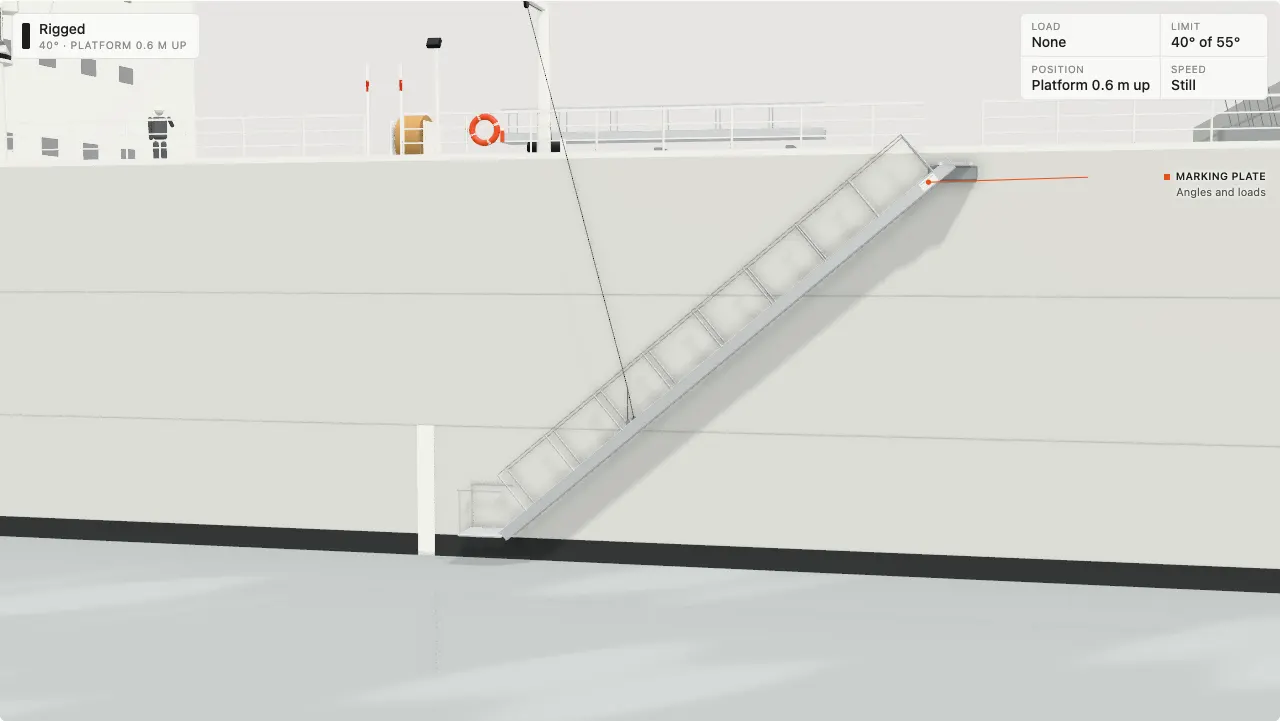
The basics
Everyone who boards or leaves a ship in port walks over the gangway or the accommodation ladder: crew, pilots, surveyors, agents, stevedores, families. When one collapses, or a hoisting wire parts, people fall between the ship and the quay or into the water. The weak points are usually ordinary ones: a corroded fitting where aluminium meets steel, a wire never renewed, a bent stanchion, a ladder rigged steeper than it was designed for.
SOLAS regulation II-1/3-9 makes inspection and maintenance of these means of access a duty on every ship, and IMO’s guidelines were revised in 2025. The revision, MSC.1/Circ.1331/Rev.1, updates the construction standards for equipment installed from 1 July 2026 and adds rules on safety nets and the protection of the crew who rig them. Click the parts of the ladder below.
Sign in to read the rest of this lesson
Continue reading
Save your progress, open all 115 lessons and get a Course completed card when you finish.
or use your email
In the rest of this lesson
- Try it: Parts of an accommodation ladder to check
- In plain words
- In detail
- What the rules say
- Flag and class notes
- Key numbers
- What inspectors find
- 4 questions people ask
- Quiz: 6 questions
- Ask our engineers about this lesson
Familiarisation training from Al Safwan Academy. Finishing a course shows completion of online familiarisation training: it is not an STCW, flag-approved or manufacturer qualification, and these courses don't replace that training. The manufacturer's manual and your flag's rules always come first.