Lesson 3 · 15 min
Proof load tests on board – test weights, water bags and dynamometers
You will be able to plan and witness a crane or derrick load test step by step and spot the errors that make the certificate worthless.
Start here
The 2-minute primer
New to this? These 6 cards explain the lesson in plain words. Go through them first and the lesson will make sense.
Primer done.
-
1/6Picture this
You can’t test a scale with a guess
Imagine checking a bathroom scale by standing on it holding a bag of “about 10 kilos” of shopping. If you don’t know what the bag really weighs, the test tells you nothing.
A crane load test is the same. The test only counts if everyone knows exactly what was hanging from the hook.
-
2/6The big idea
A test is only as good as its planning
A load test means the crane lifts more than it ever will at work. It proves the steel, the brakes and the base are sound.
Four things make it valid. The weight is truly known. The master confirms in writing that the ship can take it. The load is lifted where it stresses the crane most. And a qualified examiner checks the crane afterwards and signs.
-
3/6Words you'll meet
Six words, in plain English
- Test weights
- blocks or bags whose weight has been properly measured, used to load the crane for its test.
- Water bags
- large bags filled with water, easy to carry and fill bit by bit, but still weighed.
- Load cell
- a calibrated sensor in the rigging that measures how heavy the hanging load is.
- Dynamometer
- a weighing device that pulls against the deck instead of lifting real weights, allowed only in narrow cases.
- Radius
- how far out from the crane’s centre the hook is when the load is lifted.
- Stability
- the ship’s ability to stay upright when a heavy load swings out over its side.
-
4/6Why it matters
Most mistakes happen before the lift
A heavy test load far over the side can tip a small ship or crush a hatch cover. Weights of unknown mass can overload the crane far beyond the planned margin.
A sloppy test also produces a worthless certificate. Inspectors spot missing radii, unweighed weights and safety switches left disconnected after the test.
-
5/6In this lesson
What you’ll be able to do
- Plan a crane or derrick load test step by step.
- Check that the test weights, or water bags, are truly verified.
- Know when a dynamometer may be used and when it may not.
- Read the certificate and spot what makes it worthless.
-
6/6Quick check
What must the master give before a test load goes over the side?
Right: the qualified examiner should not start until the master confirms in writing that the ship will stay safe.
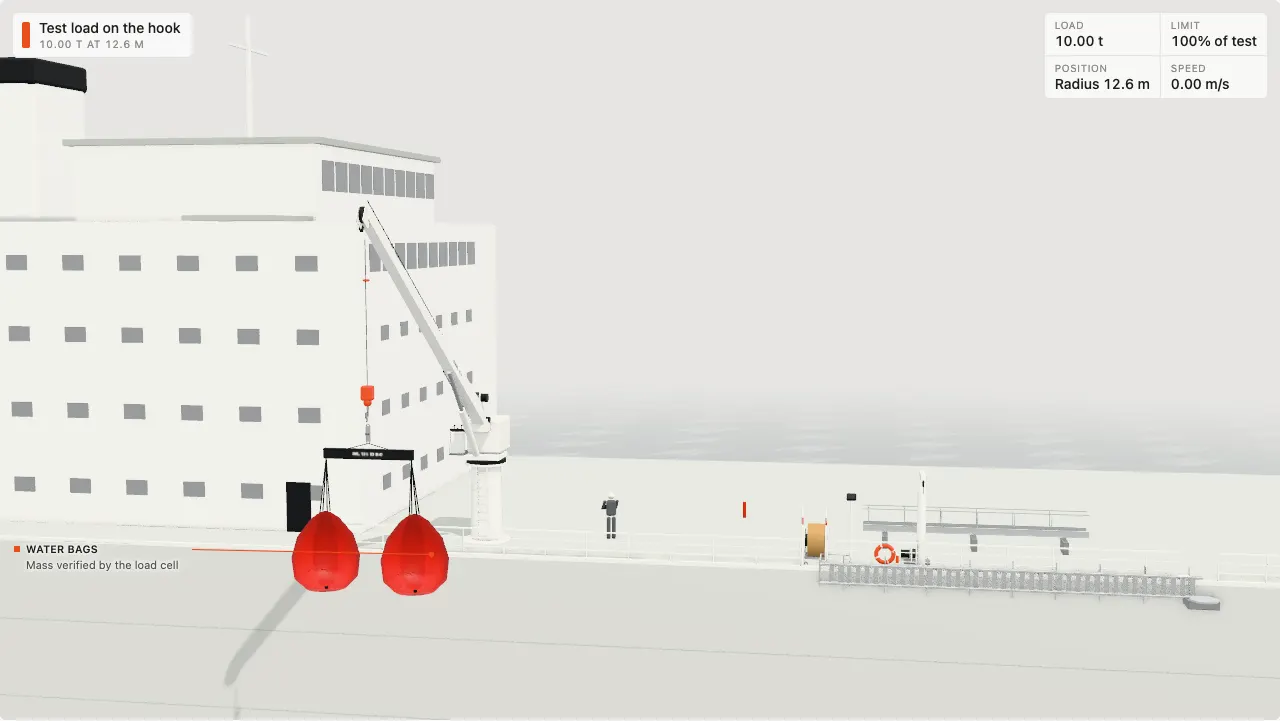
The basics
A load test deliberately loads a crane beyond anything it will lift in service. Done well, it proves the structure, the brakes and the foundations. Done badly, it can capsize a small ship, crush a hatch cover, overload the crane far beyond the intended margin, or produce a certificate for a test that never really took place.
Most of the mistakes are made before the test load leaves the quay: weights of unknown mass, no stability check, a radius that was never measured, or a dynamometer used where weights were required. This lesson walks through the test day as the ILO code of practice describes it, with the points the competent person will check.
Sign in to read the rest of this lesson
Continue reading
Save your progress, open all 115 lessons and get a Course completed card when you finish.
or use your email
In the rest of this lesson
- Try it: Test day on No. 3 crane (SWL 25 t at 22 m)
- In plain words
- In detail
- What the rules say
- Flag and class notes
- Key numbers
- What inspectors find
- 4 questions people ask
- Quiz: 6 questions
- Ask our engineers about this lesson
Familiarisation training from Al Safwan Academy. Finishing a course shows completion of online familiarisation training: it is not an STCW, flag-approved or manufacturer qualification, and these courses don't replace that training. The manufacturer's manual and your flag's rules always come first.