Lesson 8 · 16 min
Pilot ladders and transfer arrangements – the rules now and from 2028
You will be able to check a pilot ladder and its rigging against today's rules and prepare the ship for the 2028 standard, including the 30 and 36 month limits.
Start here
The 2-minute primer
New to this? These 6 cards explain the lesson in plain words. Go through them first and the lesson will make sense.
Primer done.
-
1/6Picture this
A climbing rope with a use-by date
Think of a climber’s rope. Even if it looks fine, climbers retire it after a set time, because sun and wear weaken it from the inside.
From 2028 a pilot ladder works the same way. It gets a fixed life, and it comes off the ship when that life is up, whatever it looks like.
-
2/6The big idea
The pilot’s climb must be safe every time
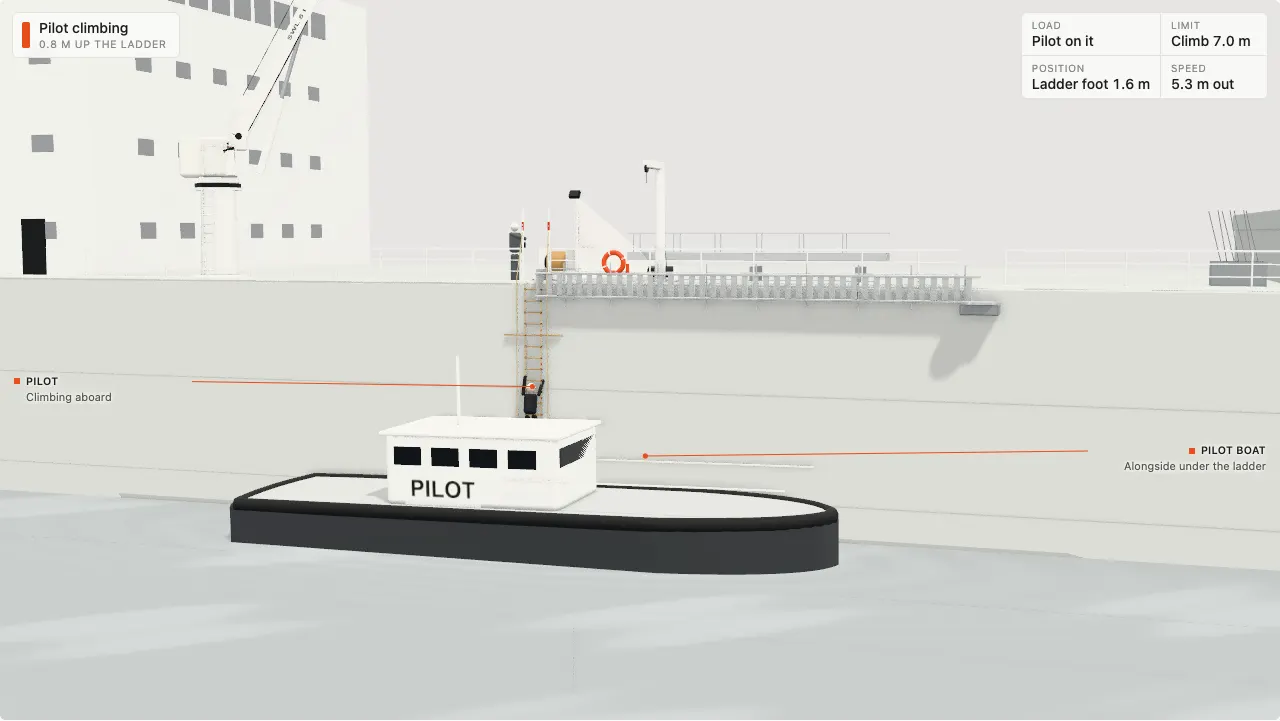
A pilot is the local expert who guides a ship into port. To board, they climb a rope ladder up the ship’s side, from a small boat, often at night and in a swell.
Everything they use must be right: the ladder, the side ropes, the strong points it is tied to, the lighting and a lifebuoy. A new mandatory standard comes into force on 1 January 2028.
-
3/6Words you'll meet
Six words, in plain English
- Pilot
- a local expert who comes aboard to guide the ship safely in and out of port.
- Pilot ladder
- a rope ladder with wooden or rubber steps, hung over the side for the pilot to climb.
- Spreader step
- a longer step that stops the ladder from twisting.
- Strong point
- a dedicated, marked fitting on deck that the ladder is tied to.
- Manropes
- two ropes the pilot can hold at the top of the ladder.
- Combination arrangement
- an accommodation ladder used with the pilot ladder when the climb is over 9 m.
-
4/6Why it matters
A fall goes into the sea or the boat
A side rope can part, a step can turn, or the ladder may not be tied to proper strong points. Then the pilot falls into the water or onto the pilot boat.
Problems are common. In one pilots’ campaign, 35% of the problem reports involved ladders not tied to strong points. Port inspectors find these faults often.
-
5/6In this lesson
What you’ll be able to do
- Check a pilot ladder and its rigging against today’s rules.
- Work out when a ladder must be withdrawn under the 2028 limits.
- Know the checks before and after each use, and every three months.
- Tell when the climb is too high for the pilot ladder alone.
-
6/6Quick check
From 2028, when must a pilot ladder come off the ship?
Right: every ladder, spares included, has a fixed life under the new standard, and the earlier of the two dates applies.
The basics
A pilot climbs a rope ladder up the vertical side of a moving ship, at night, in a swell, from a boat that rises and falls under them. If a side rope parts, a step turns, or the ladder is not secured to proper strong points, the fall is into the water or onto the pilot boat. Australia’s maritime safety authority notes that numerous incidents and fatalities involving seafarers and pilots have occurred worldwide.
The pilots’ own data show how common the problems are. In the International Maritime Pilots’ Association (IMPA) 2026 safety campaign, 13% of 4,051 pilot transfers reported were non-compliant, pilot ladders were the leading source of non-compliance, and 35% of the non-compliant reports involved ladders not secured to strong points. IMO has responded with a new, mandatory performance standard that enters into force on 1 January 2028 and applies to every pilot ladder at sea, whatever its age.
Sign in to read the rest of this lesson
Continue reading
Save your progress, open all 115 lessons and get a Course completed card when you finish.
or use your email
In the rest of this lesson
- Try it: Pre-arrival check at the pilot station, March 2028
- In plain words
- In detail
- What the rules say
- Flag and class notes
- Key numbers
- What inspectors find
- 4 questions people ask
- Quiz: 6 questions
- Ask our engineers about this lesson
Familiarisation training from Al Safwan Academy. Finishing a course shows completion of online familiarisation training: it is not an STCW, flag-approved or manufacturer qualification, and these courses don't replace that training. The manufacturer's manual and your flag's rules always come first.