Lesson 2 · 15 min
Annual thorough examination and the five-yearly load test
You will be able to plan the 12-monthly and five-yearly cycle and calculate the test load for any crane, derrick or item of loose gear.
Start here
The 2-minute primer
New to this? These 6 cards explain the lesson in plain words. Go through them first and the lesson will make sense.
Primer done.
-
1/6Picture this
A check-up every year, a stress test every five
Think of a lift in an office block. Every year an engineer looks it over closely. Now and then it is loaded with more weight than its sign allows, to prove it still has strength to spare.
A ship’s crane lives the same life. A close look every year, and a heavy test lift every five years.
-
2/6The big idea
A fixed rhythm and a fixed margin
Every 12 months a qualified examiner checks the whole crane closely. Every 5 years, and after any big repair, the crane lifts a test weight heavier than its safe limit, then gets checked again.
How much heavier is not guesswork. A table sets it: 25% extra for small cranes, 5 tonnes extra in the middle range, and 10% extra for heavy cranes.
-
3/6Words you'll meet
Five words, in plain English
- Thorough examination
- a close, step-by-step check of the whole crane by a qualified examiner, every 12 months.
- Load test
- lifting a weight heavier than the crane’s safe limit, to prove the structure still has a margin.
- Test load
- the exact weight used in a load test, worked out from the crane’s safe limit.
- Proof test
- the strength test for shackles, hooks and blocks, with a much bigger margin over their limit.
- Major repair
- work that changes the crane’s strength or main structure, such as a new slewing bearing, which triggers a new load test.
-
4/6Why it matters
Hidden wear shows up too late
Rust inside the crane’s base or a crack in a weld can stay hidden until the day a load drops. The yearly check and the five-yearly test catch that early.
Getting the numbers wrong hurts too. A test weight that is too light proves nothing. One that is far too heavy can overload the crane during the very test meant to protect it.
-
5/6In this lesson
What you’ll be able to do
- Plan the 12-monthly and five-yearly cycle for each crane.
- Work out the test load for any crane from its safe limit.
- Know which repairs call for a new load test straight away.
- Tell what the yearly examination looks at closely.
-
6/6Quick check
How often does a ship’s crane get a load test?
Right: the yearly event is the close examination. The heavy test lift comes every five years, when new, and after big repairs.
The basics
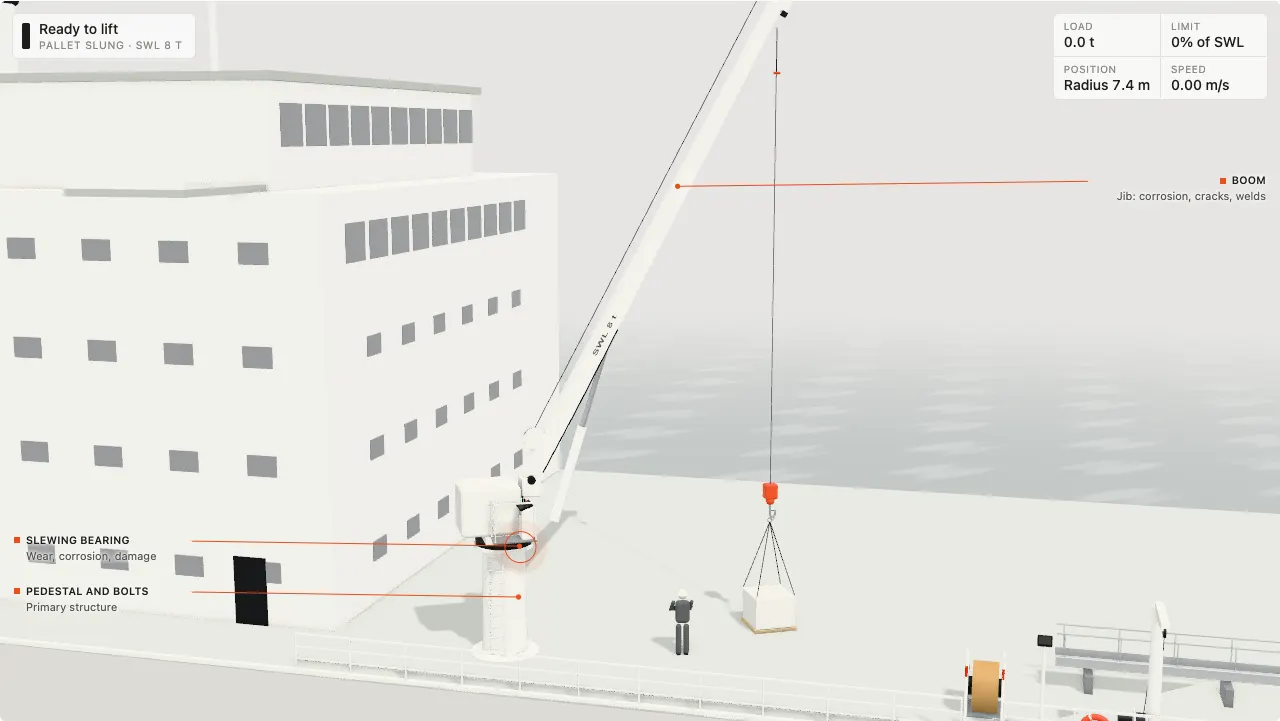
A ship’s crane works for years at or near its safe working load (SWL). Corrosion in the pedestal, a cracked weld on the jib or a worn slewing bearing can go unseen until the day the crane drops a load or collapses. The two oldest defences in the book are simple: a competent person looks at everything closely every year, and every five years the crane lifts more than it is ever allowed to lift in service, under controlled conditions, to prove the structure still has a margin.
The numbers behind that test are not a matter of opinion. They come from a table that the ILO has used for decades and that IMO copied into the SOLAS guidelines in 2023. Try it below, then read how the cycle works.
Sign in to read the rest of this lesson
Continue reading
Save your progress, open all 115 lessons and get a Course completed card when you finish.
or use your email
In the rest of this lesson
- Try it: Test load for a ship's crane or derrick
- In plain words
- In detail
- What the rules say
- Flag and class notes
- Key numbers
- What inspectors find
- 4 questions people ask
- Quiz: 6 questions
- Ask our engineers about this lesson
Familiarisation training from Al Safwan Academy. Finishing a course shows completion of online familiarisation training: it is not an STCW, flag-approved or manufacturer qualification, and these courses don't replace that training. The manufacturer's manual and your flag's rules always come first.