Lesson 2 · 16 min
Annual liferaft servicing at an approved service station
You will know what happens to your liferaft at each service, which extra tests fall due in years 5, 10 and beyond, and how to keep the interval legal.
Start here
The 2-minute primer
New to this? These 6 cards explain the lesson in plain words. Go through them first and the lesson will make sense.
Primer done.
-
1/6Picture this
A yearly check-up for a folded raft
Think of a car’s yearly road test. The car goes to an approved garage, a trained mechanic checks the brakes and lights, and you drive away with a certificate.
A liferaft gets the same each year. It leaves the ship in its box, goes to an approved workshop, is unpacked, blown up and checked, then packed again with a new certificate.
-
2/6The big idea
The only time anyone sees inside
The raft stays sealed in its box until the day it is needed. The yearly service is the one chance to look inside.
The technician pumps it up and it must hold its pressure for an hour. Seams, floor, gas bottle, food, water and flares are all checked. As the raft gets older, the tests get tougher, and old rafts that fail are taken out of use.
-
3/6Words you'll meet
Five words, in plain English
- Service station
- a workshop approved by the ship’s country of registration, with staff trained by the raft’s maker.
- Working pressure
- the normal air pressure the raft is pumped up to for its yearly test.
- Gas inflation test
- every fifth year, the raft is blown up with its own gas bottle to prove the whole system works.
- NAP test
- necessary additional pressure test, pumping an older raft up harder than normal to find weak seams.
- Dated items
- things in the raft that expire, like food, water and flares, swapped if they expire before the next service.
-
4/6Why it matters
Faults found in the workshop, not the sea
A raft with a weak seam or a leaking gas bottle looks fine in its box. Only a proper service shows the problem.
A raft serviced late, or by a workshop that is not approved, also causes trouble in port. Inspectors check the certificate and the dates on the box, and missing or late paperwork is a common finding.
-
5/6In this lesson
What you’ll be able to do
- Know what a workshop does at every yearly service.
- Tell which extra tests fall due in year 5, year 10 and beyond.
- Know when the 12-month interval can be stretched, and who decides.
- Check a workshop is approved before sending a raft ashore.
-
6/6Quick check
What extra test comes every fifth year?
Right: every five years the raft’s own gas bottle is used instead of air, to prove the whole inflation system works.
The basics
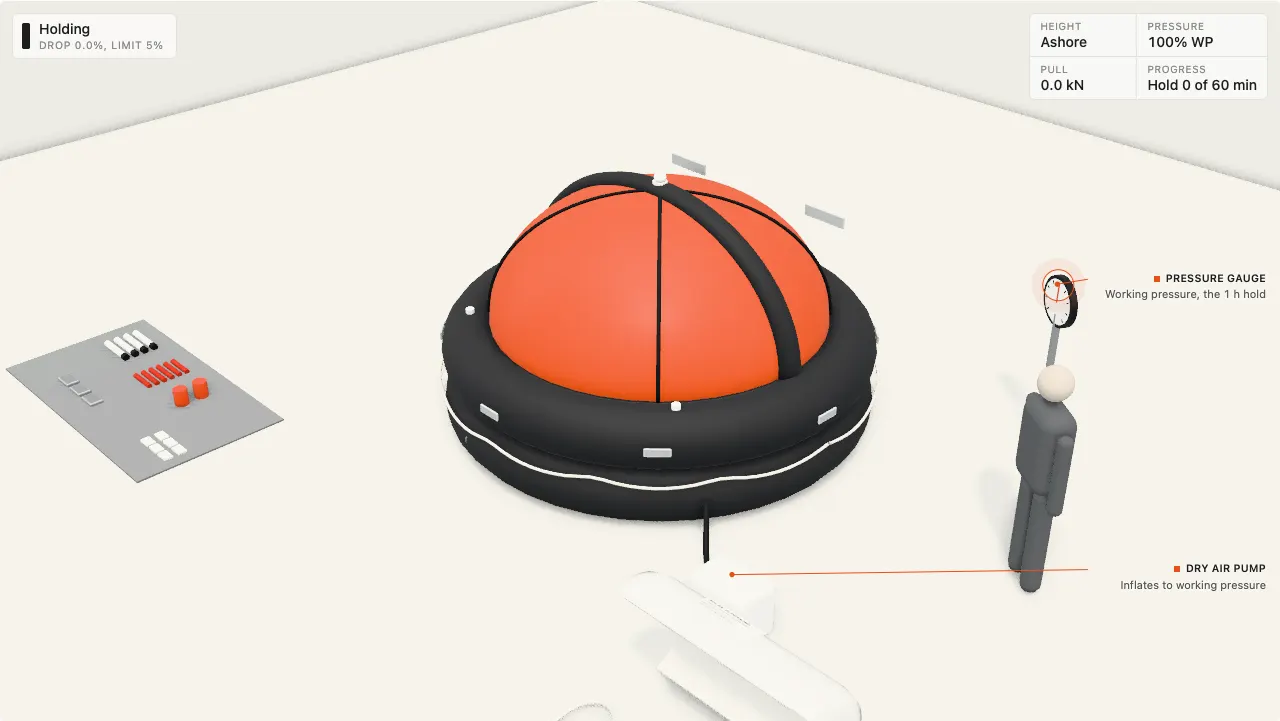
Once a year every inflatable liferaft leaves the ship in its canister and goes to a workshop. There a technician trained by the raft’s maker cuts the seals, lifts out the folded raft and pumps it up. For at least an hour the raft has to hold its pressure. Every seam is examined, the floor is walked on, the gas bottle is weighed and the food, water and flares are checked against their expiry dates. Then the raft is packed again, bone dry, and sent back with a certificate.
This is the only time anyone sees the inside of the raft before the day it is needed. The tests get harder as the raft gets older: a real gas inflation every five years, and after the tenth year a pressure test at up to twice the working pressure every single year. Knowing this schedule lets you read a service certificate properly, plan around the ship’s trading pattern, and spot a raft that is nearing the end of its life.
Sign in to read the rest of this lesson
Continue reading
Save your progress, open all 115 lessons and get a Course completed card when you finish.
or use your email
In the rest of this lesson
- Try it: The life of an inflatable liferaft, from monthly checks to year 25
- In plain words
- In detail
- What the rules say
- Flag and class notes
- Key numbers
- What inspectors find
- 3 questions people ask
- Quiz: 6 questions
- Ask our engineers about this lesson
Familiarisation training from Al Safwan Academy. Finishing a course shows completion of online familiarisation training: it is not an STCW, flag-approved or manufacturer qualification, and these courses don't replace that training. The manufacturer's manual and your flag's rules always come first.