Lesson 8 · 13 min
EPIRB and SART: annual tests and shore-based maintenance
You will know what the radio surveyor checks on the EPIRB and SART each year, what happens at shore-based maintenance, and how to keep the beacon's identity right.
Start here
The 2-minute primer
New to this? These 6 cards explain the lesson in plain words. Go through them first and the lesson will make sense.
Primer done.
-
1/6Picture this
A beacon with a passport
Think of a passport. It says who you are. If it still shows an old name or the wrong country, it causes trouble exactly when you need it most.
A ship’s emergency beacon carries an identity code too. When it calls for help, rescuers read that code to know which ship is in trouble and who to contact. It must be right.
-
2/6The big idea
A last call for help, checked every year
If the ship sinks, the EPIRB floats free, switches itself on and sends a distress message by satellite. A SART goes into the survival craft and helps rescuers home in on it.
Every year a radio surveyor checks the beacon without sending a real alert. At least every five years it goes ashore for a full check-up in a screened room, usually with a new battery.
-
3/6Words you'll meet
Five words, in plain English
- EPIRB
- emergency position-indicating radio beacon, a buoy that floats free and sends a distress message by satellite.
- SART
- search and rescue transponder, a device in the survival craft that shows up on a searching ship’s radar.
- AIS-SART
- a SART that shows on the ship-tracking screen instead of on radar.
- Hex ID
- the beacon’s identity code, printed on its label and sent with every message.
- Shore-based maintenance
- the full check-up in an approved workshop ashore, at least every five years.
-
4/6Why it matters
Help sent to the wrong place
A beacon that still carries the previous owner’s identity sends rescuers looking for the wrong ship and the wrong contacts.
A flat battery, an expired release unit or a rope tying the beacon to its bracket can keep it silent or drag it down. And a beacon set off by accident can start a real search unless someone tells the rescue centre at once.
-
5/6In this lesson
What you’ll be able to do
- Know what the radio surveyor checks on the beacon each year.
- Know what happens at the five-yearly check-up ashore.
- Check that the beacon’s identity and registration are right.
- Check the SARTs and their battery dates.
-
6/6Quick check
Why must the beacon’s identity code be correct?
Right: rescuers read the code to find out which ship is in trouble and who to contact.
The basics
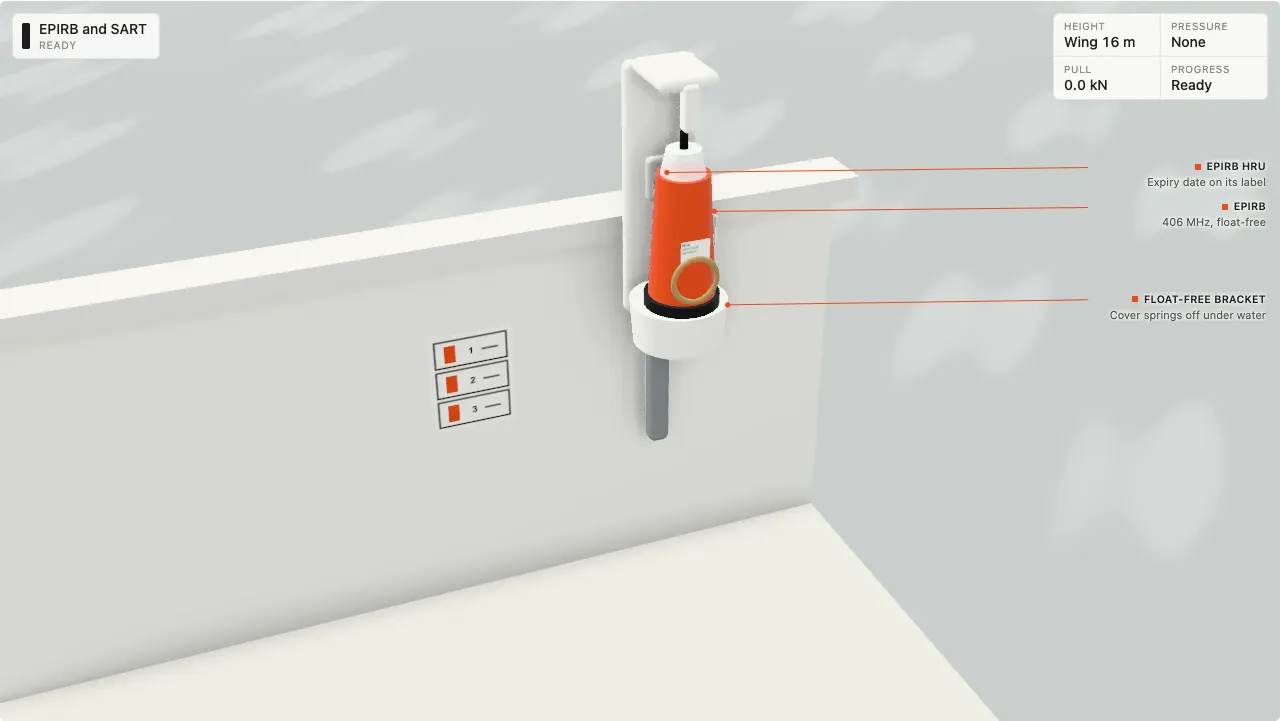
When a ship sinks, the emergency position-indicating radio beacon (EPIRB) floats free of its bracket, switches itself on and sends a 406 MHz distress message to the Cospas-Sarsat satellites with the ship’s identity and, on modern beacons, a satellite position. A search and rescue transponder (SART) then guides rescuers to the survivors: a radar SART paints a line of dots on the searching ship’s radar, an AIS-SART shows up on its automatic identification system (AIS) display.
None of that helps if the beacon’s identity code belongs to the ship’s previous owner, the battery has run out, or the hydrostatic release has expired. Those are exactly the things the radio surveyor checks at the annual test, and the reason a beacon goes ashore at least every five years for a full maintenance in a radio-screened room. This lesson takes you through both, and through the SART checks that go with them.
Sign in to read the rest of this lesson
Continue reading
Save your progress, open all 115 lessons and get a Course completed card when you finish.
or use your email
In the rest of this lesson
- Try it: Annual radio survey: the EPIRB and the SARTs
- In plain words
- In detail
- What the rules say
- Flag and class notes
- Key numbers
- What inspectors find
- 4 questions people ask
- Quiz: 6 questions
- Ask our engineers about this lesson
Familiarisation training from Al Safwan Academy. Finishing a course shows completion of online familiarisation training: it is not an STCW, flag-approved or manufacturer qualification, and these courses don't replace that training. The manufacturer's manual and your flag's rules always come first.