Lesson 1 · 15 min · Open to everyone
Liferaft types and how they are stowed
You will be able to name each part of a liferaft stowage, say why it is there, and spot the rigging mistakes that stop a raft from floating free.
Start here
The 2-minute primer
New to this? These 6 cards explain the lesson in plain words. Go through them first and the lesson will make sense.
Primer done.
-
1/6Picture this
A raft that launches itself
Think of the airbag in a car. Nobody presses a button in a crash. It is packed away, folded tight, and a sensor sets it off by itself at the right moment.
A liferaft works the same way. If the ship sinks too fast for anyone to act, the raft must float off, blow itself up and break free on its own.
-
2/6The big idea
A few ropes decide everything
Most rafts sit in a box on a cradle, held down by straps. If the ship sinks, a small unit cuts the straps under water and the box floats up.
As it rises it pulls out a long rope tied to the ship, and that pull fills the raft with gas. Then a weak part of the rope snaps, and the raft is free.
-
3/6Words you'll meet
Five words, in plain English
- Cradle
- the frame on deck that the raft’s box sits in, built so nothing stops the box lifting off.
- Painter
- the long rope from the raft to the ship that, when pulled, sets off the inflation.
- Weak link
- a part of the rope made to snap once the raft is up, so the sinking ship cannot drag it down.
- HRU
- hydrostatic release unit, a small device that cuts the straps when water pressure pushes on it a few metres down.
- Throw-overboard raft
- a raft you simply throw over the side, or that floats off by itself.
-
4/6Why it matters
Rigging mistakes made on a dry day
The ropes and straps are rigged by the crew in port, long before any emergency. Inspectors keep finding the same faults.
A painter tied straight to the cradle may let the raft inflate but never break free. A loose painter can let it float away flat. An extra lashing “to be safe” can keep it on deck for good.
-
5/6In this lesson
What you’ll be able to do
- Name the main liferaft types and how each one is launched.
- Point to each part of the stowage and say why it is there.
- Read the label on the raft’s box.
- Spot the rigging mistakes that stop a raft from floating free.
-
6/6Quick check
What should the painter be tied to?
Right: the weak link holds while the raft inflates, then snaps so the raft is not pulled under with the ship.
The basics
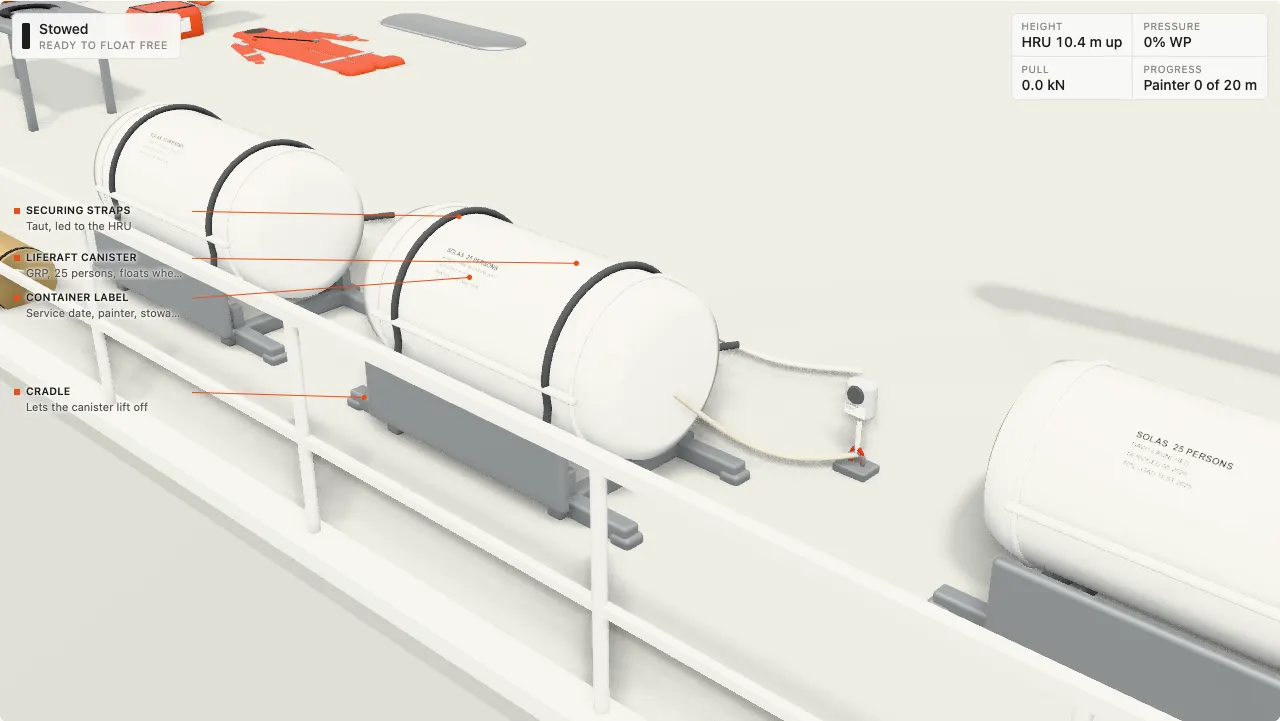
When a ship sinks fast, nobody launches the liferaft. The raft has to do it alone: the canister floats off its cradle, pulls out its painter, the pull fires the gas bottle, the raft inflates on the surface and a weak link snaps before the ship can drag it down. Every step depends on a few pieces of rope, a strap and a small release unit that were rigged by the crew on a dry day in port.
That is why inspectors look at liferaft stowage so closely. In 2021 the Australian Maritime Safety Authority (AMSA) issued over 100 deficiencies for wrongly fitted hydrostatic release units on liferafts and float-free EPIRBs, and warned that a painter not tied to the weak link can stop the raft from inflating or from leaving the ship at all. This lesson shows you the whole arrangement, part by part, and the rules behind each part.
In plain words
A liferaft is a tent on an inflatable ring, packed into a box. Most cargo ships carry rafts that you simply throw over the side, or that float off by themselves if the ship sinks. Some ships, mostly passenger ships, carry bigger rafts that are lowered full of people by a small crane called a davit. A few ships carry rigid rafts that need no inflation.
The raft box sits in a cradle on deck and is held down by straps. The straps meet at a small release unit that works by water pressure. If the ship sinks, the release unit cuts the straps a few metres under water and the box floats up. As it rises it pulls out a long rope, the painter, which is still tied to the ship. That pull opens the gas bottle and the raft inflates. Then a deliberately weak link in the rope breaks, and the raft is free.
Everything therefore depends on the rope being tied to the right place: to the weak link, which is tied to the ship. Tie it straight to the cradle and the raft may inflate but never break free. Leave it loose and the raft may float away without inflating. Add an extra lashing “to be safe” and it may never leave the deck.
In detail
The types you will meet
| Type | How it is launched | Where it is defined |
|---|---|---|
| Throw-overboard inflatable | Thrown over the side by hand or floats free; boarded from the water or by ladder | LSA Code 4.1 and 4.2 |
| Davit-launched inflatable | Lowered by a launching appliance with people on board, hung from a lifting hook | LSA Code 4.1.4 and 4.2.8 |
| Rigid liferaft | Thrown over or floats free; no inflation | LSA Code 4.3 |
| MES liferaft | Floats off next to a marine evacuation system and is boarded from its platform | LSA Code 6.2.3 (lesson 4) |
The International Life-Saving Appliance (LSA) Code sets the build standard. Every liferaft must survive 30 days afloat in all sea conditions and work after being dropped into the water from 18 m. If it is stowed higher than 18 m above the lightest seagoing waterline it must be of a type drop-tested from at least that height. A raft that is not served by a launching appliance and is meant for side-to-side transfer must weigh no more than 185 kg with its container and equipment.35
Each raft carries an emergency pack. The full pack, marked “SOLAS A PACK”, includes 4 rocket parachute flares, 6 hand flares, 2 buoyant smoke signals, food and 1.5 litres of water per person, seasickness tablets and thermal protective aids. Passenger ships on short international voyages may be allowed the smaller “SOLAS B PACK”.3
How many rafts a cargo ship carries
SOLAS regulation III/31 sets the number. A cargo ship with totally enclosed lifeboats on each side also carries liferafts for everyone on board. If these rafts are stowed for easy side-to-side transfer at a single open deck level, 100% capacity in total is enough. If not, each side needs rafts for 100% of the people on board. A cargo ship under 85 m (other than a tanker or gas carrier) may carry liferafts instead of lifeboats: rafts on each side for everyone on board and, unless they are stowed for easy side-to-side transfer at a single open deck level, extra rafts so that each side can take 150% of the people on board. A ship with a stern free-fall lifeboat carries liferafts for 100% on each side, and the rafts on at least one side must be served by launching appliances. On a ship where the nearest survival craft is more than 100 m from the bow or stern, an extra raft goes as far forward or aft as is practicable; this raft may be fastened for manual release only.2
The stowage rules
SOLAS regulation III/13 says each survival craft must be stowed so it does not interfere with any other craft, as near the water as is safe, in a state of continuous readiness, fully equipped, and as far as practicable sheltered from damage by fire and explosion. For liferafts it adds three specific rules:1
- The painter is permanently attached to the ship.
- Each raft or group of rafts has a float-free arrangement complying with LSA Code 4.1.6, so that it floats free and, if inflatable, inflates automatically when the ship sinks.
- Rafts can be released by hand, one raft or container at a time.
The extra forward raft under III/31.1.4 is exempt from the first two. Davit-launched rafts must be stowed within reach of the lifting hooks. Throw-overboard rafts must be readily transferable to either side unless each side already has the full required capacity.1
Ro-ro passenger ships have stricter rules: their liferafts must be served by marine evacuation systems or by launching appliances, have float-free stowage, boarding ramps, and be either self-righting or canopied reversible.11
The float-free chain
LSA Code section 4.1.6 defines the painter system, the weak link and the HRU; the explorer above gives the requirement for each. Remember the order of events: HRU cuts the straps at no more than 4 m, the buoyant container rises and pulls out the painter, the pull fires the gas, the raft inflates, the weak link breaks. A fault anywhere in that chain stops the raft.34
What the container tells you
Read the container label before anything else. The LSA Code lists what it must show: maker, serial number, approving authority and capacity, the word SOLAS, the type of emergency pack, the date of the last service, painter length, maximum permitted stowage height above the waterline, launching instructions and, since the 2008 amendments, the mass of the packed raft if it is over 185 kg.45
Check that the stowage height on deck does not exceed the marked maximum, and that the painter length on the label suits the height of the cradle above the lightest seagoing waterline.
The crew’s routine
- Weekly: all survival craft and launching appliances are visually inspected to make sure they are ready for use, and the inspection is logged (SOLAS III/20.6).6
- Monthly: the life-saving appliances are inspected with the checklist from the ship’s on-board maintenance instructions (SOLAS III/36.1) and the result is entered in the log-book (SOLAS III/20.7.2).6
- Every four months, if davit-launched rafts are fitted: on-board training in their use, including inflation and lowering of a raft whenever practicable. A special training raft may be used if it is conspicuously marked and not counted as life-saving equipment (SOLAS III/19.4.3).7
A practical monthly walk-round for each raft: straps intact and correctly led to the HRU, HRU in date or in service, painter tied to the weak link, weak link shackled to a strong point, container undamaged with drain holes clear, label legible, service date within interval, nothing stowed on top or lashed across.
What the rules say
- SOLAS regulation III/13.4 requires every liferaft to be stowed with its painter permanently attached to the ship, with a float-free arrangement to LSA Code 4.1.6, and so that rafts can be released by hand one at a time.1
- SOLAS regulation III/31.1 sets the number of liferafts on cargo ships, and III/31.1.4 adds a raft forward or aft where the nearest survival craft is more than 100 m from the bow or stern.2
- LSA Code paragraph 4.1.6.2 requires a weak link in the float-free arrangement to break under a strain of 2.2 ± 0.4 kN.3
- LSA Code paragraph 4.1.6.3 requires an HRU to release the raft at a depth of not more than 4 m and not to release when seas wash over it.3
- LSA Code paragraph 4.1.3.2 sets the painter length at no less than 10 m plus the stowage height above the lightest seagoing waterline, or 15 m, whichever is greater.3
- LSA Code paragraph 4.1.2.2, as amended by MSC.218(82), limits a raft intended for side-to-side transfer and not served by a launching appliance to 185 kg including container and equipment.5
- SOLAS regulations III/20.6 and III/20.7.2 require a weekly visual inspection of survival craft and a monthly inspection using the maintenance checklist, both recorded in the log-book.6
- SOLAS regulation III/19.4.3 requires on-board training with davit-launched liferafts at intervals of not more than four months.7
Flag and class notes
- The IMO survey guidelines that flag administrations and class societies use for the annual safety equipment survey (resolution A.1186(33)) tell the surveyor to examine each survival craft and its equipment, the HRU and float-free arrangements of inflatable liferafts, to check that hand flares are in date, and to verify that rafts for side-to-side transfer weigh less than 185 kg.10
- AMSA advises that securing straps be taut but not over-tight, because both over-tensioning and too little load on the HRU can stop it working, and that no extra lashings be added.8
- Flag administrations may add their own requirements for stowage and for the approval of HRUs. Look up your flag’s marine notices on life-saving appliances and ask your class society’s statutory department; lessons 2 and 3 show examples from the Bahamas, Singapore and the UK.
Key numbers
| What | Value |
|---|---|
| Weak link breaking strain | 2.2 ± 0.4 kN3 |
| HRU release depth | not more than 4 m3 |
| Minimum painter length | 10 m + stowage height above lightest waterline, or 15 m if greater3 |
| Painter breaking strength | 15 kN (over 25 persons), 10 kN (9 to 25), 7.5 kN (others)3 |
| Drop height a liferaft must survive | 18 m, or the actual stowage height if higher3 |
| Maximum mass for side-to-side transfer | 185 kg with container and equipment5 |
| Extra liferaft at the ends | when nearest survival craft is more than 100 m from bow or stern2 |
| Davit-launched liferaft training | at least every 4 months7 |
What inspectors find
- Painter not connected, or its connection to the weak link not fitted as required. The Indian Register of Shipping’s 2024 report on port state control (PSC) inspections of its fleet lists both, the weak-link case twice.9
- HRU wrongly fitted or over-tensioned straps; AMSA issued over 100 such deficiencies in 2021.8
- Raft identification label blank or service date not marked, and rafts not stowed level in their cradles.9
- Embarkation ladders for liferafts rotten, frayed around the thimbles, or not secured to a strong point.9
- HRU service record or survey report expired; the same report lists this among the detainable deficiencies of 2024.9
Questions people ask
Can I add a padlock or an extra lashing to stop the raft being stolen or washed away?
No. Anything that holds the canister besides the straps through the HRU can stop the raft floating free. SOLAS also requires rafts to be releasable by hand one at a time. If you need extra security in heavy weather, ask the HRU and liferaft manufacturer what their system allows.
Does the forward liferaft need an HRU?
The extra raft required by SOLAS III/31.1.4 is exempt from the permanently attached painter and float-free rules and may be fastened for manual release only. Many owners still fit an HRU. Check what your flag and the ship’s Record of Equipment say.
Is a raft on a ship with lifeboats really needed?
Yes. On cargo ships the liferafts are in addition to the lifeboats, so that everyone has a place even if one side cannot be used.
Check yourself
6 questions · pass with 60% to complete the lesson
Save your score and continue
An account keeps this result, opens lesson 2 and the rest of the course, and gives you a Course completed card when you finish.
or use your email
When you're done
Question about this lesson?
Ask our team
Stuck on something, or think a part could be clearer? Our engineers read every question and answer you by email. Only you and our team can see what you write.
Sign in to ask
or use your email
Sources (11)
- 1 International Convention for the Safety of Life at Sea (SOLAS) 1974, chapter III, regulation 13 (Stowage of survival craft), as adopted by IMO Resolution MSC.47(66) (adopted 4 June 1996, in force 1 July 1998). imo.org
- 2 SOLAS chapter III, regulation 31 (Survival craft and rescue boats, cargo ships), paragraphs 1.1 to 1.4, as adopted by Resolution MSC.47(66). imo.org
- 3 International Life-Saving Appliance (LSA) Code, IMO Resolution MSC.48(66) (adopted 4 June 1996), section 4.1 (paragraphs 4.1.1.2, 4.1.3.2, 4.1.5.1 and 4.1.6). imo.org
- 4 LSA Code, Resolution MSC.48(66), section 4.2.6 (Containers for inflatable liferafts). imo.org
- 5 IMO Resolution MSC.218(82), Amendments to the LSA Code (adopted 8 December 2006, in force 1 July 2008), amendments to paragraphs 4.1.2.2 and 4.2.6.3. imo.org
- 6 IMO Resolution MSC.152(78), Amendments to SOLAS (adopted 20 May 2004, in force 1 July 2006), new SOLAS regulations III/20.6 and III/20.7; and SOLAS regulation III/36 as adopted by MSC.47(66). imo.org
- 7 SOLAS chapter III, regulation 19.4.3 (on-board training in the use of davit-launched liferafts), as adopted by Resolution MSC.47(66). imo.org
- 8 Australian Maritime Safety Authority, Safety Alert 02/2021, Correct use of hydrostatic release units (reproduced in Indian Register of Shipping Technical Circular 060/2021). irclass.org
- 9 Indian Register of Shipping, PSC Annual Report 2024, tables of detainable and non-detainable deficiencies, life-saving appliances. irclass.org
- 10 IMO Resolution A.1186(33), Survey Guidelines under the Harmonized System of Survey and Certification (HSSC), 2023 (adopted 6 December 2023), Annex, items (EA) 1.2.2.20 and 1.2.2.21. imo.org
- 11 SOLAS chapter III, regulation 26.2 (Liferafts on ro-ro passenger ships), as adopted by Resolution MSC.47(66). imo.org
Familiarisation training from Al Safwan Academy. Finishing a course shows completion of online familiarisation training: it is not an STCW, flag-approved or manufacturer qualification, and these courses don't replace that training. The manufacturer's manual and your flag's rules always come first.