Lesson 4 · 14 min
Marine evacuation systems and rotational deployment
You will be able to plan an MES rotation, run a deployment the way the flag expects, and know what to do when one fails.
Start here
The 2-minute primer
New to this? These 6 cards explain the lesson in plain words. Go through them first and the lesson will make sense.
Primer done.
-
1/6Picture this
An aeroplane slide for a ship
Think of the inflatable slide at an aeroplane door. It stays packed away for years, but in an emergency one pull sends it out, full of air, ready for people to slide down.
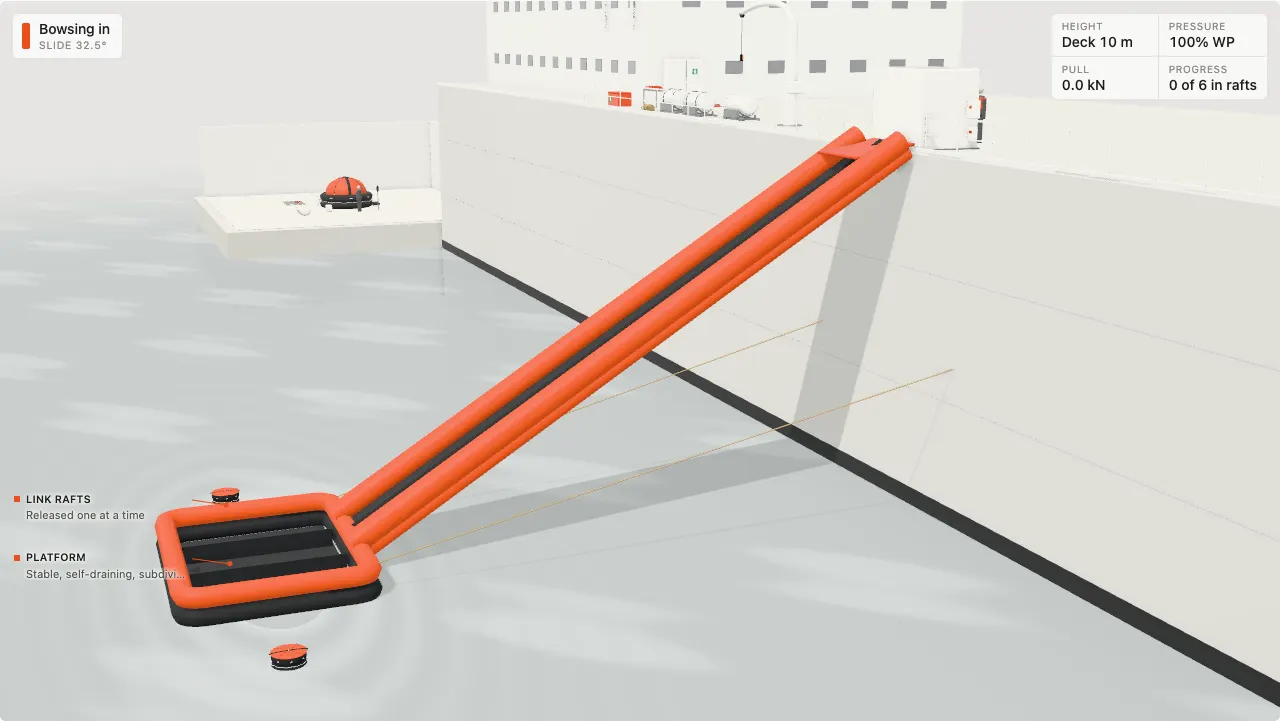
A marine evacuation system is the ship version. A slide or chute unrolls down the ship’s side to a floating platform, with liferafts waiting alongside for hundreds of people.
-
2/6The big idea
Serviced every year, really tested every six
Each system goes to an approved workshop every year to be opened, checked and repacked.
But the only real proof is a deployment from the ship itself, in harbour, in front of a surveyor. Each system must be deployed this way at least once every six years. Ships with several systems take turns, and each deployment is graded and doubles as the best training the crew will get.
-
3/6Words you'll meet
Five words, in plain English
- MES
- marine evacuation system, a slide or chute from the ship down to a floating platform and liferafts.
- Platform
- the floating deck at the bottom of the slide, where people step across into the rafts.
- Rotational deployment
- setting off each system from the ship in turn, so every one is tried within six years.
- Bowsing lines
- ropes that pull the platform in close and hold it against the ship’s side.
- Flag
- the country where the ship is registered, whose rules and surveyors it must satisfy.
-
4/6Why it matters
Hardly anyone has seen one work
Most crew have never seen their system go out. If it fails on the real day, hundreds of people may be stuck on board.
A test deployment shows the truth. If the maker’s technician quietly fixes a jam during the test, the problem stays hidden, so flags such as the UK and the Bahamas count that as a fail. Faults found must be traced to their cause and put right.
-
5/6In this lesson
What you’ll be able to do
- Name the parts of a system and what each one does.
- Plan a deployment rotation that meets the six-year limit.
- Grade a deployment as a pass, a partial pass or a fail.
- Know what to do after a deployment fails.
-
6/6Quick check
How often is each system deployed from the ship?
Right: each system must be deployed from the ship at least once every six years, in turn with the others on board.
The basics
A marine evacuation system (MES) is the big inflatable slide or chute you see in a box on the side of a ferry or cruise ship. Pull the handle and, in a few minutes, a passage unrolls down the ship’s side to a floating platform, liferafts inflate alongside, and hundreds of people slide or drop into them. Hardly anyone on board has seen it happen.
That is the problem the rules try to solve. An MES is serviced every year, but the only time anyone finds out whether it really deploys is at installation and at its rotational test deployment, at least once every six years. The UK raised unsuccessful MES deployments at the IMO’s Maritime Safety Committee, and both the UK and the Bahamas now collect a report on every deployment, graded as a pass, a partial pass or a fail.7 This lesson walks you through the decisions an operator and a master face around that deployment.
Sign in to read the rest of this lesson
Continue reading
Save your progress, open all 115 lessons and get a Course completed card when you finish.
or use your email
In the rest of this lesson
- Try it: Planning and running a rotational MES deployment
- In plain words
- In detail
- What the rules say
- Flag and class notes
- Key numbers
- What inspectors find
- 4 questions people ask
- Quiz: 6 questions
- Ask our engineers about this lesson
Familiarisation training from Al Safwan Academy. Finishing a course shows completion of online familiarisation training: it is not an STCW, flag-approved or manufacturer qualification, and these courses don't replace that training. The manufacturer's manual and your flag's rules always come first.