Lesson 5 · 12 min
Lifejackets and lifejacket lights
You will know how many lifejackets of which sizes a ship needs, what makes one compliant, and who checks, services or replaces what and when.
Start here
The 2-minute primer
New to this? These 6 cards explain the lesson in plain words. Go through them first and the lesson will make sense.
Primer done.
-
1/6Picture this
A toy that always rocks upright
Think of a wobbly toy with a weighted base. Knock it over and it rocks back upright by itself, every time, with nobody helping.
A lifejacket does the same in the water. It must turn a person face up, even someone who is unconscious, and keep their mouth out of the water. Every person on board has one.
-
2/6The big idea
One for everyone, checked every month
A ship carries a lifejacket for every person, plus spares where people stand watch. Passenger ships also carry child and baby sizes.
Each jacket is bright orange, with a whistle and a small light. Some are solid foam. Others are inflatable: a slim collar that fills with gas when it hits the water. The crew check them all monthly, and inflatable ones go ashore for a service once a year.
-
3/6Words you'll meet
Five words, in plain English
- Inflatable lifejacket
- a slim jacket with a gas cylinder that fills it with gas when it lands in water.
- Lifejacket light
- a small white light on the jacket that helps rescuers find you in the dark.
- Retro-reflective tape
- shiny strips that flash back brightly when a searchlight shines on them.
- IMO symbol
- a standard picture on lockers and boxes showing what is stored inside, understood in any language.
- Record of Equipment
- the official list of safety equipment the ship must carry, which inspectors check against.
-
4/6Why it matters
Small faults, easy to fix
A light with a flat battery is no help in the dark. A missing child lifejacket leaves a child without one.
These are some of the commonest findings in inspections: a light past its date, a missing child size, a box without its symbol. None are hard to fix, so inspectors see them as a sign of how carefully the monthly check is done.
-
5/6In this lesson
What you’ll be able to do
- Work out how many lifejackets of each size a ship needs.
- Know what makes a lifejacket and its light pass the rules.
- Run a proper monthly check of every jacket.
- Tell who services, checks or replaces what, and when.
-
6/6Quick check
What happens to an inflatable lifejacket once a year?
Right: inflatable lifejackets follow the same yearly rule as liferafts, serviced at an approved station.
The basics
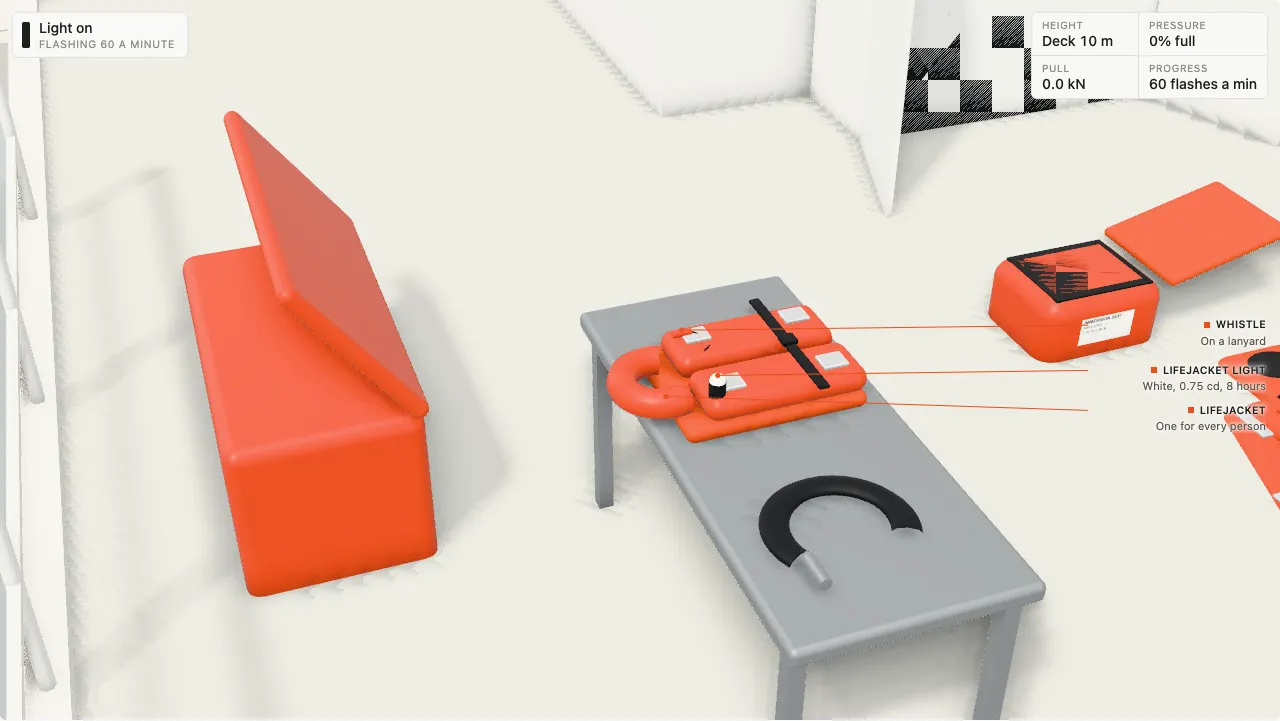
A lifejacket is the one piece of life-saving equipment every person on board is given. It has to work for someone who has never worn one, in the dark, after a jump from the deck, and keep an unconscious person’s mouth out of the water. Since 2010 the IMO standard has been tested against a reference lifejacket on real volunteers, and it covers infants, children and people up to 140 kg.
Lifejackets are also one of the commonest small findings in surveys and port state control (PSC) inspections: a missing child lifejacket that is listed on the ship’s Record of Equipment, a light with an expired battery, a stowage box without its symbol. None of these are hard to fix, which is why inspectors treat them as a sign of how well the monthly inspection is done.
Sign in to read the rest of this lesson
Continue reading
Save your progress, open all 115 lessons and get a Course completed card when you finish.
or use your email
In the rest of this lesson
- Try it: Who deals with it, and when?
- In plain words
- In detail
- What the rules say
- Flag and class notes
- Key numbers
- What inspectors find
- 4 questions people ask
- Quiz: 5 questions
- Ask our engineers about this lesson
Familiarisation training from Al Safwan Academy. Finishing a course shows completion of online familiarisation training: it is not an STCW, flag-approved or manufacturer qualification, and these courses don't replace that training. The manufacturer's manual and your flag's rules always come first.