Lesson 3 · 13 min
Hydrostatic release units: disposable, serviceable and rigged right
You will know how an HRU works, how to tell when it is due, how to fit one correctly, and what the surveyor and PSC officer check.
Start here
The 2-minute primer
New to this? These 6 cards explain the lesson in plain words. Go through them first and the lesson will make sense.
Primer done.
-
1/6Picture this
A latch that opens under water
Think of a sprinkler head in an office ceiling. It sits there for years doing nothing. When heat reaches it, it opens by itself, with nobody pressing anything.
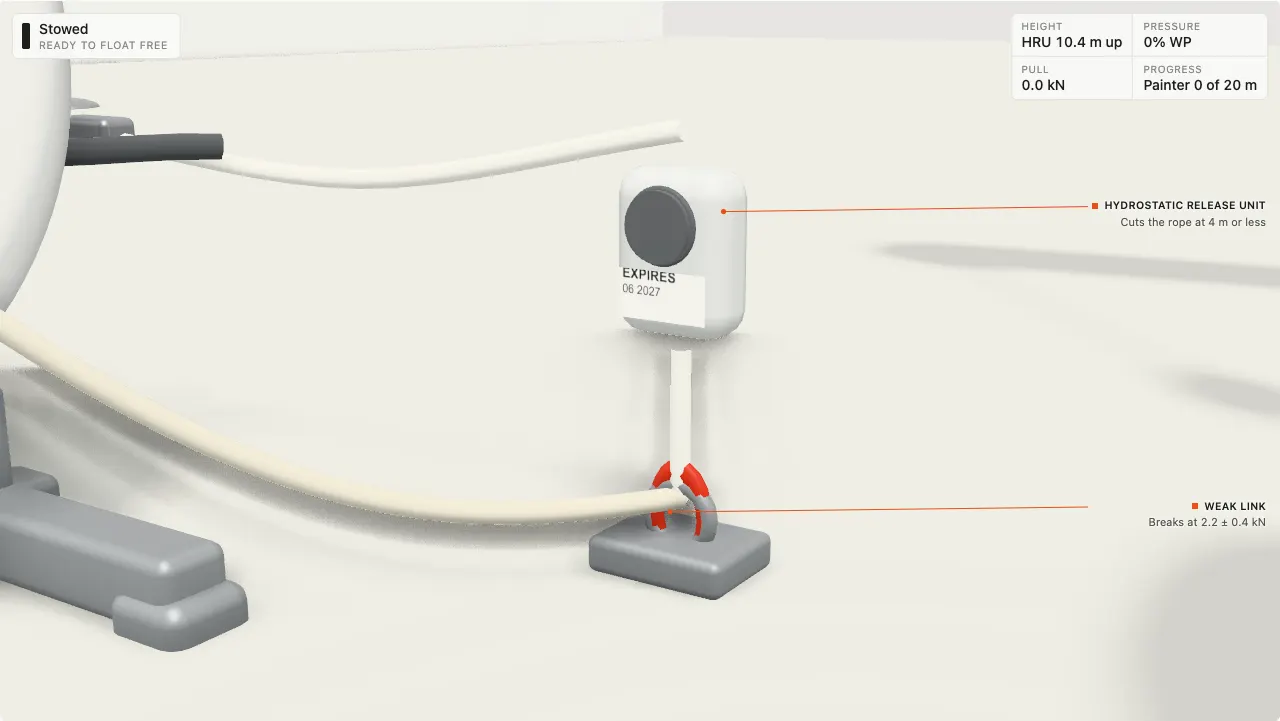
A hydrostatic release unit is like that, but water pressure is the trigger. A few metres under water it cuts the rope that holds the liferaft down, and the raft floats up.
-
2/6The big idea
Small, cheap and it decides everything
The release unit is the cheapest part of a liferaft set-up, yet it decides whether the raft ever leaves a sinking ship.
It sits outside in sun, salt and frost for years, so it has its own dates. Some units are thrown away and replaced when their date runs out. Others are opened and serviced every year. Either way, they only work if rigged exactly as the maker shows.
-
3/6Words you'll meet
Five words, in plain English
- HRU
- hydrostatic release unit, a small sealed unit that cuts a rope when water pressure pushes on it.
- Disposable HRU
- a unit with a fixed life from its maker, replaced with a new one when its date runs out.
- Serviceable HRU
- a heavier unit that a service station opens, checks and tests at least once a year.
- Float-free
- set up so the equipment releases and floats to the surface by itself if the ship sinks.
- EPIRB
- emergency position-indicating radio beacon, a buoy that floats free and sends a distress signal by satellite.
-
4/6Why it matters
An out-of-date unit can hold the raft
If the unit is past its date, rigged wrongly or fighting an extra lashing, the raft may stay tied to the sinking ship.
Inspectors find these faults often: expired units, straps pulled far too tight, painters tied in the wrong place, and extra ropes round beacon housings. Each one is easy to fix on a dry day in port.
-
5/6In this lesson
What you’ll be able to do
- Tell a disposable unit from a serviceable one.
- Work out when a unit is due and how far an extension can go.
- Fit and check a unit the way the maker shows.
- Know what the surveyor and port inspector look for.
-
6/6Quick check
What happens to an expired disposable unit?
Right: a disposable unit is never serviced or extended. When its date passes, it is replaced.
The basics
A hydrostatic release unit (HRU) is the cheapest part of a liferaft installation and the one that decides whether the raft ever leaves the ship. It is a small sealed chamber with a membrane and a blade. When the ship sinks, water pressure pushes the membrane in at a few metres’ depth, the blade cuts the rope holding the raft’s straps, and the canister floats up. The same idea frees a float-free EPIRB from its bracket.
Because the HRU sits outside in sun, salt and frost for years, the rules give it its own servicing cycle, separate from the raft. Many HRUs on ships today are disposable: they are not serviced but replaced when the date on their label runs out. Get the date or the rigging wrong and the raft may be held to the ship. This lesson includes a calculator to work out when an HRU or any annually serviced item is due, and the latest date a flag extension could allow.
Sign in to read the rest of this lesson
Continue reading
Save your progress, open all 115 lessons and get a Course completed card when you finish.
or use your email
In the rest of this lesson
- Try it: When is the HRU (or liferaft) due, and how far can an extension go?
- In plain words
- In detail
- What the rules say
- Flag and class notes
- Key numbers
- What inspectors find
- 4 questions people ask
- Quiz: 6 questions
- Ask our engineers about this lesson
Familiarisation training from Al Safwan Academy. Finishing a course shows completion of online familiarisation training: it is not an STCW, flag-approved or manufacturer qualification, and these courses don't replace that training. The manufacturer's manual and your flag's rules always come first.