Lesson 14 · 6 min
Hydraulic accumulators: how nitrogen stores oil under pressure
An accumulator stores oil under pressure by squeezing nitrogen in a bladder. How much oil it gives back depends on the precharge and the working pressure range, not just its size.
Start here
The 2-minute primer
New to this? These 6 cards explain the lesson in plain words. Go through them first and the lesson will make sense.
Primer done.
-
1/6Picture this
A power bank for oil
A phone power bank stores energy while it is plugged in, then gives it back when you are out. But your phone needs a minimum charge to work, so only part of what the power bank holds is really useful.
An accumulator is a power bank for oil. It stores oil under pressure and gives it back when the pump can’t keep up or has stopped.
-
2/6The big idea
Squeezed gas pushes the oil back out
Inside a steel bottle is a rubber bag, a bladder, filled with nitrogen gas. Oil pumped in squeezes the gas, like pressing a spring. When a machine needs oil, the gas pushes it back out.
Only some of the stored oil is useful. It is the oil that comes out between the top pressure and the lowest pressure the machine can still work at.
-
3/6Words you'll meet
Five words, in plain English
- Accumulator
- a steel bottle that stores oil under pressure, ready to give back.
- Bladder
- the rubber bag inside the bottle that holds the gas.
- Nitrogen
- a gas that doesn’t burn or react with oil, the only gas used in accumulators.
- Precharge
- the gas pressure put into the bladder before oil goes in. Oil can only enter above it.
- Usable volume
- the oil the accumulator actually gives back between its top and bottom working pressures.
-
4/6Why it matters
Stored pressure stays after the pump stops
Accumulators keep steering gear, watertight doors and emergency systems working. If the gas leaks away, almost no oil is stored, the pump starts and stops constantly and the pressure jumps.
A charged accumulator still holds energy with the pump off. Opening a fitting before it is isolated and bled to zero can hurt someone. Air or oxygen instead of nitrogen can catch fire.
-
5/6In this lesson
What you’ll be able to do
- Explain how gas in a bladder stores oil.
- Know why only part of the oil is useful, and how precharge changes it.
- Spot lost precharge, too much precharge and a burst bladder.
- Check precharge safely and know which gas to use.
-
6/6Quick check
Which gas goes into an accumulator?
Right: only dry nitrogen is used. Oxygen and oil under pressure can catch fire, so never charge with oxygen or air.
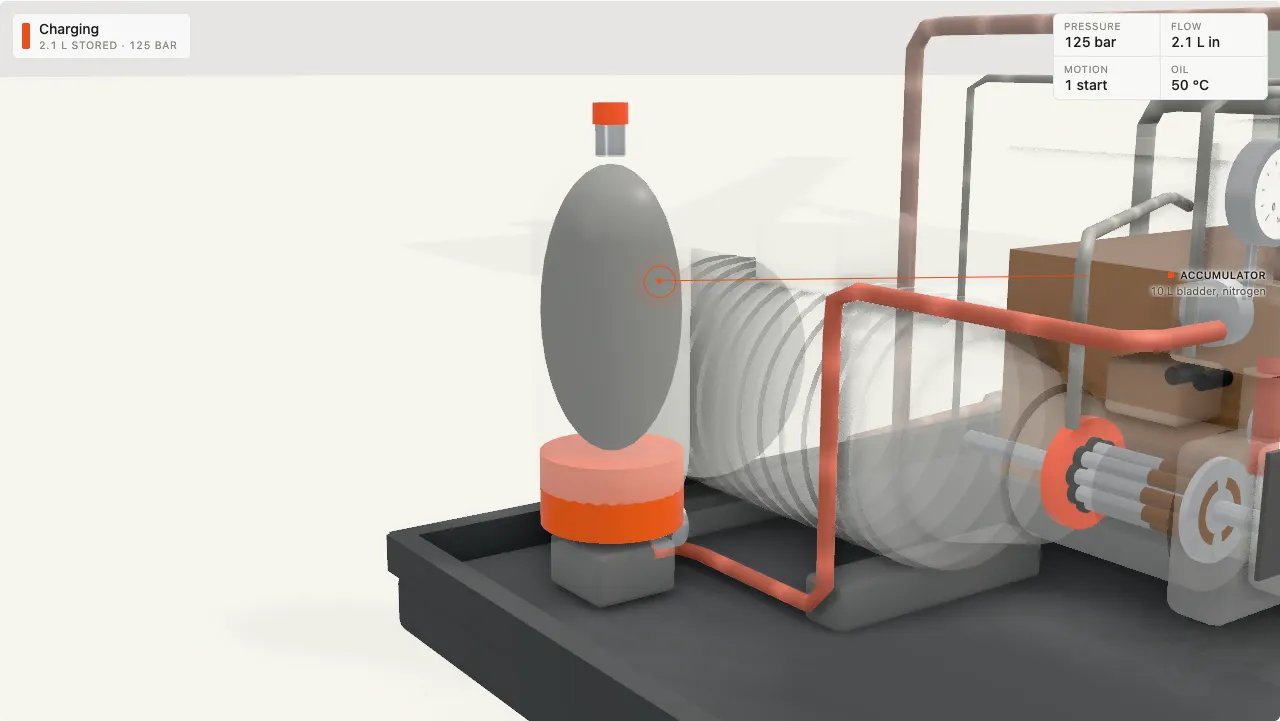
An accumulator is a hydraulic battery. A steel bottle holds a rubber bladder full of nitrogen. Oil pumped in squeezes the gas, and the squeezed gas pushes the oil back out when the system needs it. Accumulators keep watertight doors, steering gear, emergency systems and big presses working when the pump can’t keep up or has stopped. Charge it, use it and break it above.
In simple terms
Nitrogen behaves like a spring you can’t see. Before the accumulator is connected, the bladder is filled with nitrogen to a set pressure, the precharge. Oil can only get in once the system pressure is higher than that.
As the pump pushes oil in, the bladder gets smaller and the gas pressure rises. When the pump stops, the gas holds the oil at that pressure. When a machine needs oil, the gas pushes it out, and the pressure falls as the bladder grows again.
The important part is that only some of the oil is useful. A machine needs a minimum pressure to work. The oil you can actually use is what comes out between the maximum pressure (where the pump stops) and that minimum. The orange band on the chart is that useful part. Change the precharge and watch it grow or shrink.
The faults are the problems we meet on service visits:
- Lost precharge. Nitrogen slowly escapes through the gas valve or the bladder. The bladder ends up crushed into the top of the shell, the useful oil drops to almost nothing, the pump starts and stops constantly, and pressure swings hard.
- Precharge too high. Oil can’t get in at all, so the accumulator does nothing.
- Burst bladder. Gas mixes with the oil and the accumulator stops working, often with foaming oil and spongy machine movement.
Safety: a charged accumulator holds energy even with the pump switched off. Never loosen a fitting on its circuit until it is isolated and the oil side has been bled to zero on a gauge.
- Play with it: Precharge, minimum and maximum pressure and size, with the pressure–volume curve drawn live.
- Break it: lost precharge, precharge set too high, and a burst bladder.
Sign in to read the rest of this lesson
Continue reading
Save your progress, open all 115 lessons and get a Course completed card when you finish.
or use your email
In the rest of this lesson
- Interactive animation: Bladder accumulator and its gas curve
- For engineers
- Deep dive
- Key numbers
- 4 questions people ask
- Quiz: 4 questions
- Ask our engineers about this lesson
Familiarisation training from Al Safwan Academy. Finishing a course shows completion of online familiarisation training: it is not an STCW, flag-approved or manufacturer qualification, and these courses don't replace that training. The manufacturer's manual and your flag's rules always come first.