Lesson 10 · 6 min
Check valves and pilot-operated check valves: how a load is held
A check valve lets oil through one way and blocks it the other. A pilot-operated check adds a small piston that can push it open on command, so a cylinder holds its load until you deliberately lower it.
Start here
The 2-minute primer
New to this? These 6 cards explain the lesson in plain words. Go through them first and the lesson will make sense.
Primer done.
-
1/6Picture this
A turnstile with a staff key
A stadium exit turnstile lets you walk out, but it won’t turn the other way. Push from the outside and it simply stays put.
Staff carry a key that unlocks it on purpose, to let someone back through. A pilot-operated check valve is that turnstile and that key, built for oil.
-
2/6The big idea
Hold the load until you choose
A check valve is a ball or poppet, a seat and a light spring. Oil pushing one way lifts it and flows. Oil pushing the other way presses it onto its seat, and the heavier the load, the tighter it seals.
A pilot-operated check adds a small piston that pushes it open on command, so the load comes down only when you lower it.
-
3/6Words you'll meet
Five words, in plain English
- Check valve
- a one-way valve that lets oil through in one direction and blocks it in the other.
- Seat
- the ring the poppet presses against to seal.
- Pilot piston
- the small piston behind the poppet that pushes it open to let the load down.
- Pilot line
- a thin line carrying pressure from the lowering side to the pilot piston.
- Pilot ratio
- how much bigger the pilot piston is than the seat. A bigger ratio needs less pressure to open.
-
4/6Why it matters
Loads that drift, loads that won’t come down
These valves hold hatch covers, outriggers, davit arms and press rams in place. A particle of dirt on the seat stops the poppet closing, so the load sinks slowly.
A blocked or crushed pilot line does the opposite: the load won’t come down at all. Fitting the valve right on the cylinder means a burst hose can’t drop the load.
-
5/6In this lesson
What you’ll be able to do
- Follow a load through raise, hold and lower.
- Know what the pilot ratio does and how pilot pressure opens the valve.
- Tell a dirty seat from a blocked pilot line by the symptoms.
- Know why the valve belongs right on the cylinder.
-
6/6Quick check
The load won’t come down. What is likely wrong?
Right: without pressure in the pilot line, the pilot piston never pushes the poppet open, so the trapped oil keeps holding the load up.
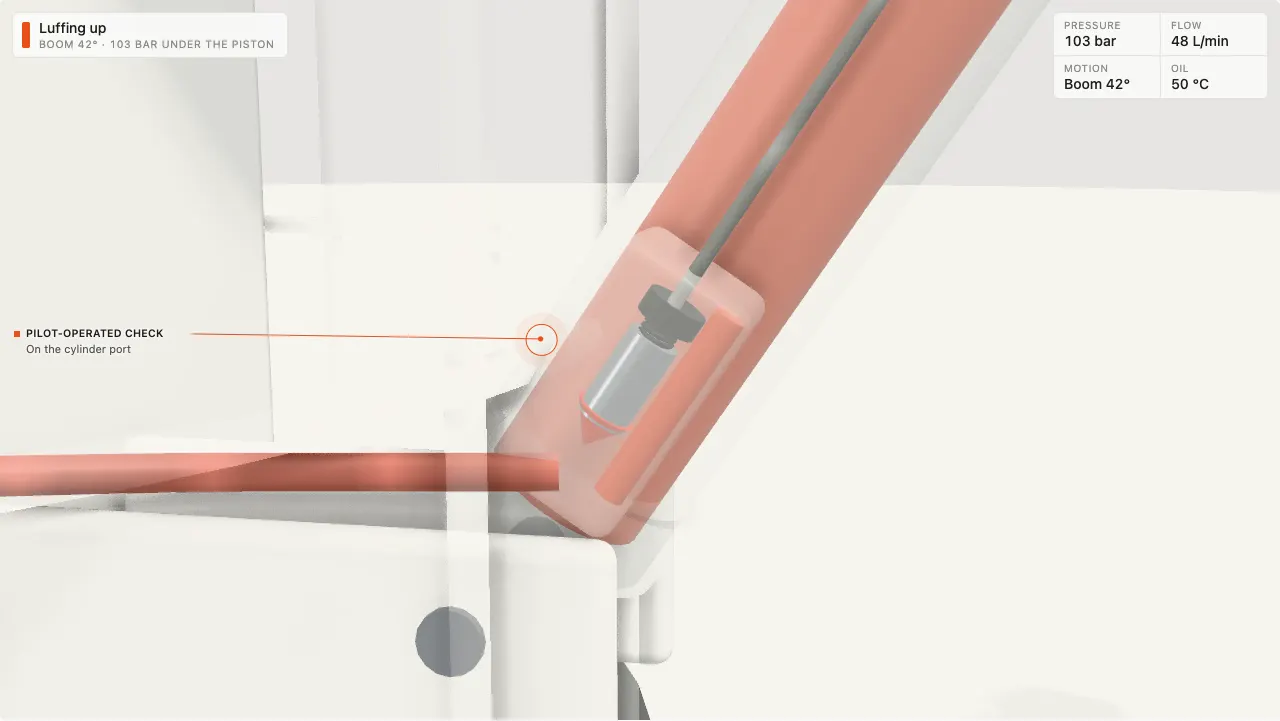
A check valve is the simplest valve in hydraulics: a ball or poppet, a seat and a light spring. Oil pushing one way lifts it and flows. Oil pushing the other way presses it harder onto its seat and stops. Add a small pilot piston that can push the poppet open on purpose and you have the pilot-operated check, the valve that holds hatch covers, outriggers, davit arms and press rams where they are. In the animation the valve sits in the line under a loaded cylinder: raise, hold, then lower, and watch the pilot piston do its job.
In simple terms
Raising. The pump pushes oil towards the cylinder. The oil lifts the poppet off its seat against a light spring and goes straight through. This part is an ordinary check valve: it needs only a couple of bar to open.
Holding. When the lever goes to Hold, the oil under the piston wants to flow back out. That pressure pushes the poppet onto its seat, and the heavier the load, the tighter it seals. Because it is metal on metal, a clean poppet holds with practically no leakage, which a spool valve can’t do.
Lowering. Now the pump feeds the top of the cylinder. That same pressure also travels down a thin pilot line to a small piston behind the poppet. The piston has a bigger area than the poppet’s seat (four times bigger in the default setting), so it only needs a quarter of the load pressure to push a pin into the poppet and open it. The oil under the piston can then flow back to tank and the load comes down.
The two faults are the two problems we find most. A particle trapped on the seat stops the poppet closing, so the load sinks slowly. A blocked or crushed pilot line means the pilot piston never gets pressure, so the load won’t come down at all.
- Play with it: Raise, hold and lower a load through a pilot-operated check, and change the pilot ratio.
- Break it: dirt under the seat (the load drifts) and a blocked pilot line (it won't come down).
Sign in to read the rest of this lesson
Continue reading
Save your progress, open all 115 lessons and get a Course completed card when you finish.
or use your email
In the rest of this lesson
- Interactive animation: Pilot-operated check valve holding a cylinder
- For engineers
- Deep dive
- Key numbers
- 4 questions people ask
- Quiz: 4 questions
- Ask our engineers about this lesson
Familiarisation training from Al Safwan Academy. Finishing a course shows completion of online familiarisation training: it is not an STCW, flag-approved or manufacturer qualification, and these courses don't replace that training. The manufacturer's manual and your flag's rules always come first.