Lesson 12 · 7 min
Hydraulic cylinders: push, pull, speed and regeneration
A cylinder turns pressure into force and flow into speed. The full piston area pushes, the ring around the rod pulls, and regeneration trades force for speed.
Start here
The 2-minute primer
New to this? These 6 cards explain the lesson in plain words. Go through them first and the lesson will make sense.
Primer done.
-
1/6Picture this
A doctor’s syringe, made of steel
Think of a syringe. Press liquid into one end and the plunger slides out. Press it into the other end and the plunger slides back in.
A hydraulic cylinder is a big, strong syringe. Oil pumped in behind a piston pushes a steel rod out in a straight line, with enough force to lift a boom or close a hatch.
-
2/6The big idea
Pressure makes force, flow makes speed
How hard a cylinder pushes depends on the oil pressure and the size of the piston. How fast it moves depends on how much oil the pump sends each minute.
Pushing is stronger than pulling, because when pulling the rod covers part of the piston face. Pulling is faster, because the smaller space on the rod side fills up more quickly.
-
3/6Words you'll meet
Six words, in plain English
- Barrel
- the steel tube the piston slides inside.
- Cap end
- the closed end of the cylinder. Oil pumped in here pushes the rod out.
- Rod end
- the end the rod comes out of. Oil pumped in here pulls the rod back in.
- Gland
- the end piece the rod slides through, holding the seals that keep oil in and dirt out.
- Regeneration
- sending the oil from the rod side round into the cap end, for more speed and less force.
- Wiper
- a seal at the very front of the gland that scrapes dirt off the rod.
-
4/6Why it matters
The part most often stripped for repair
A worn piston seal lets oil slip from one side to the other, so the cylinder gets slow and the load creeps down.
A scored rod cuts the gland seals, so new seals alone won’t last. A bent rod pushes sideways and wears the seals and bearings quickly. Knowing the basics helps you see which repair is really needed.
-
5/6In this lesson
What you’ll be able to do
- Work out why a cylinder pushes harder than it pulls.
- Explain why it moves back in faster than it moves out.
- Know what regeneration gives and what it costs.
- Spot the signs of a bypassing seal, a scored rod and a bent rod.
-
6/6Quick check
Why is a cylinder’s pull weaker than its push?
Right: when pulling, oil only presses on the ring around the rod, so the same pressure gives less force.
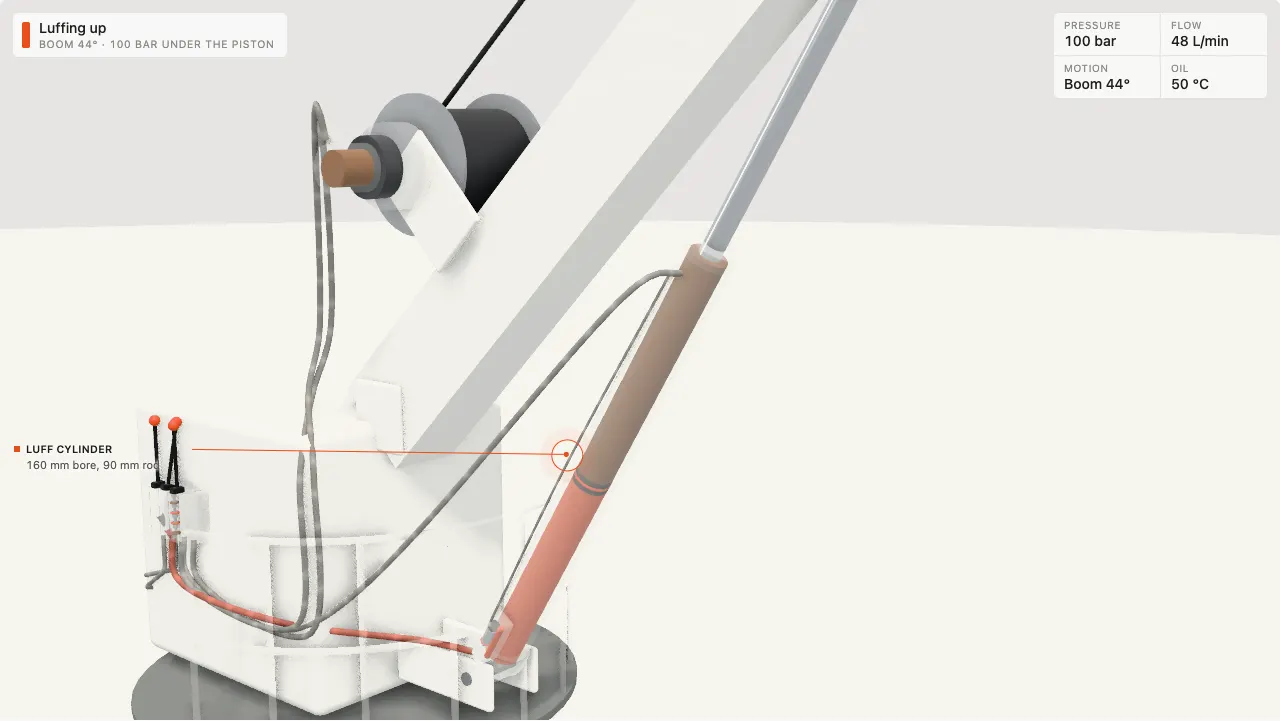
A hydraulic cylinder is the simplest part of a hydraulic system and the one we strip most often. It has one job: turn oil pressure into a straight-line force. How much force, how fast, and how long it lasts depend on a handful of numbers you can play with above: bore, rod, pressure, flow and stroke.
In simple terms
Inside the steel tube (the barrel) is a piston with seals round it, fixed to a polished steel rod. Oil pumped into the closed end (the cap end) pushes the piston and the rod comes out. Oil pumped into the other end (the rod end) pulls it back in.
Pushing is stronger than pulling. When oil pushes from the cap end it presses on the whole face of the piston. When it pulls from the rod end, the rod covers part of that face, so the oil only presses on the ring around the rod. Try a thick rod in the animation and watch the pull force drop.
Pulling is faster than pushing. The same pump flow fills the smaller space on the rod side more quickly, so the rod comes in faster than it goes out.
Regeneration is a trick for speed. Instead of sending the rod-side oil back to the tank, the valve sends it round into the cap end. Now the cylinder is filled by the pump and by itself at the same time, and the rod shoots out. The catch: oil is pushing on both sides of the piston, so only the area of the rod itself gives force. Presses and log splitters use this for a fast approach, then switch back to normal for the hard push.
The faults show what we find on the bench. A bypassing piston seal lets oil slip from one side to the other, so the cylinder gets slow and the load creeps. A scored rod cuts the gland seals, so oil weeps out and dirt gets in. A bent rod pushes sideways on the bearings and seals and wears them out quickly.
- Play with it: Bore, rod, pressure, flow and stroke, with extend, retract and regeneration.
- Break it: a bypassing piston seal, a scored rod leaking at the gland, and a bent rod.
Sign in to read the rest of this lesson
Continue reading
Save your progress, open all 115 lessons and get a Course completed card when you finish.
or use your email
In the rest of this lesson
- Interactive animation: Double-acting cylinder cutaway
- For engineers
- Deep dive
- Key numbers
- 4 questions people ask
- Quiz: 4 questions
- Ask our engineers about this lesson
Familiarisation training from Al Safwan Academy. Finishing a course shows completion of online familiarisation training: it is not an STCW, flag-approved or manufacturer qualification, and these courses don't replace that training. The manufacturer's manual and your flag's rules always come first.