Lesson 5 · 6 min
Hydraulic oil viscosity: why temperature changes everything
Viscosity is how thick the oil is. Hot oil thins and leaks through every clearance; cold oil thickens and starves the pump. Choosing the grade means keeping the oil in its ideal band at your real working temperature.
Start here
The 2-minute primer
New to this? These 6 cards explain the lesson in plain words. Go through them first and the lesson will make sense.
Primer done.
-
1/6Picture this
Honey straight from the fridge
Take honey out of the fridge and it barely slides off the spoon. Warm it up and it runs almost like water.
Hydraulic oil does the same. A typical oil is about ten times thicker at 20 °C than at 80 °C. A machine on a cool morning and on a hot afternoon is working with two very different oils.
-
2/6The big idea
Not too thick, not too thin
Viscosity is how thick the oil is. The oil has two jobs that pull in opposite directions.
It must be thin enough to flow easily through the pump, hoses and valves. It must be thick enough to seal the tiny gaps inside them and keep a film between moving metal parts. The aim is to keep it in its best band at the real working temperature.
-
3/6Words you'll meet
Five words, in plain English
- Viscosity
- how thick a liquid is, or how easily it flows. Honey is high, water is low.
- ISO VG
- the oil’s viscosity grade, its thickness at 40 °C, written as VG 32, 46 or 68.
- Viscosity index
- a number saying how much the oil thins with heat. Higher means it changes less.
- Clearance
- the tiny gap between moving parts, such as a valve spool and the hole it slides in.
- Cooler
- a radiator with a fan that takes heat out of the oil.
-
4/6Why it matters
Fine in the morning, drifting by afternoon
A machine that works perfectly early in the morning, then drifts, slows and loses pressure in the afternoon, very often has an oil temperature problem.
Hot, thin oil slips through every gap. Cylinders drift, pumps deliver less and metal starts touching metal. The oil and the seals also age much faster, so the repair bill grows.
-
5/6In this lesson
What you’ll be able to do
- Know what viscosity is and why heat changes it so much.
- Read an oil grade and a viscosity index.
- See how thin oil raises leakage inside valves and pumps.
- Know where to look first when a machine struggles in the heat.
-
6/6Quick check
It drifts only in the afternoon. Check what first?
Right: a big change between cool and hot running points at the oil thinning, so measure its temperature and check the cooler first.
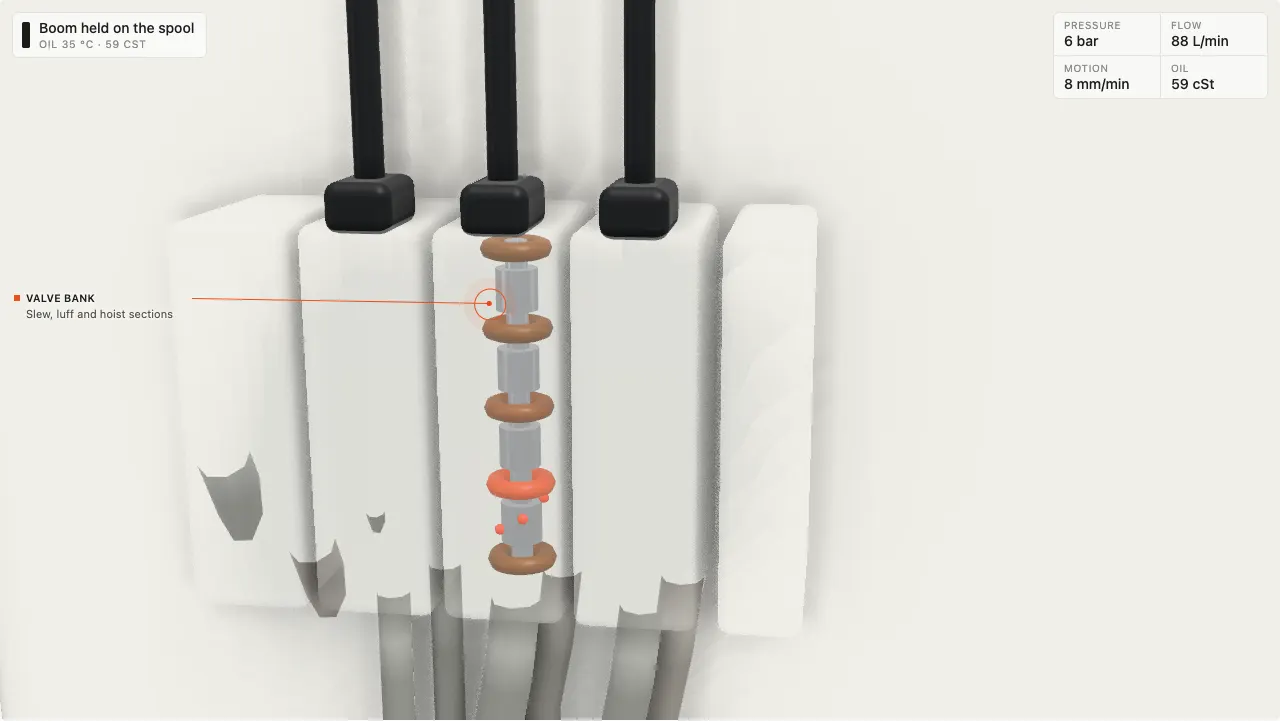
A hydraulic machine that works perfectly at 7 in the morning and drifts, slows and loses pressure by 2 in the afternoon is very often an oil temperature problem. Oil viscosity, its thickness, changes enormously with temperature, and almost everything in a hydraulic system depends on it. Move the temperature slider and watch both the chart and the oil squeezing through a valve clearance.
In simple terms
Viscosity is how easily a liquid flows. Honey is thick, water is thin. Hydraulic oil sits in between, and it changes a lot with heat: a typical oil is about ten times thicker at 20 °C than at 80 °C.
The oil has two jobs that pull in opposite directions:
- It has to be thin enough to flow easily through the pump, hoses and valves, or the pump struggles and power is wasted.
- It has to be thick enough to seal the tiny gaps inside pumps, valves and cylinders, and to keep a film between moving metal parts.
Too hot, and the oil turns thin: it slips through clearances, cylinders drift, the pump delivers less, and metal starts touching metal. Too cold, and it’s like pumping syrup: the pump can’t fill properly, the machine is sluggish and a lot of power goes into heat.
The grade (ISO VG 32, 46, 68) is the oil’s thickness at 40 °C in centistokes. A thicker grade suits machines that run hot. The viscosity index (VI) says how much the oil thins with heat: a high-VI oil changes less, so it copes better with a cold start and a hot afternoon.
Tick “Cooler failed in a Gulf summer” to see what a UAE August does to an oil chosen for a cooler climate.
- Play with it: Oil temperature, ISO VG grade and viscosity index, with a live chart and a valve clearance leaking.
- Break it: a failed cooler in summer heat, and a top-up with the wrong grade.
Sign in to read the rest of this lesson
Continue reading
Save your progress, open all 115 lessons and get a Course completed card when you finish.
or use your email
In the rest of this lesson
- Interactive animation: Viscosity, temperature and leakage
- For engineers
- Deep dive
- Key numbers
- 4 questions people ask
- Quiz: 4 questions
- Ask our engineers about this lesson
Familiarisation training from Al Safwan Academy. Finishing a course shows completion of online familiarisation training: it is not an STCW, flag-approved or manufacturer qualification, and these courses don't replace that training. The manufacturer's manual and your flag's rules always come first.