Lesson 2 · 7 min
Hydraulic pressure and flow: what each one really does
Flow decides how fast things move. Pressure is how hard the oil has to push to make that happen, and it comes from the load and from every restriction the oil passes through.
Start here
The 2-minute primer
New to this? These 6 cards explain the lesson in plain words. Go through them first and the lesson will make sense.
Primer done.
-
1/6Picture this
Your thumb over the garden hose
The tap decides how much water comes out each second. That is flow. Put your thumb over the end and the water pushes harder against your thumb. That is pressure.
Your thumb didn’t make more water. It just made the water work harder to get out.
-
2/6The big idea
Flow sets speed, the load sets pressure
A pump does not make pressure. It makes flow: a fixed amount of oil every turn. More flow means things move faster.
Pressure only appears when something resists that flow: the load on a cylinder, or a valve, hose or blockage the oil has to squeeze through. The oil pushes only as hard as it has to.
-
3/6Words you'll meet
Five words, in plain English
- Flow
- how much oil moves each minute, in litres per minute. It decides how fast things move.
- Restriction
- anything narrow the oil must squeeze through, such as a half-shut valve or a crushed hose.
- Needle valve
- a valve with a fine adjuster that narrows the path, used to slow a movement on purpose.
- Gauge
- a dial that shows the oil pressure at that point in the line.
- Relief valve
- a safety valve that sends oil back to the tank when pressure reaches its limit.
-
4/6Why it matters
Wasted push turns into heat
When a restriction makes the pump push harder than the load needs, that extra push does no work. It turns into heat in the valve or fitting.
So a pump gauge reading well above what the load needs means you are paying for a hidden blockage. If it gets bad enough, the relief valve opens and the machine slows down.
-
5/6In this lesson
What you’ll be able to do
- Tell flow and pressure apart, and what each one controls.
- See why a restriction raises the pressure only before it.
- Know why both gauges read the same once the oil stops.
- Spot the signs of a partly blocked line.
-
6/6Quick check
More oil, same load. What changes?
Right: flow sets the speed and the load sets the pressure, so more oil means more speed, not more push.
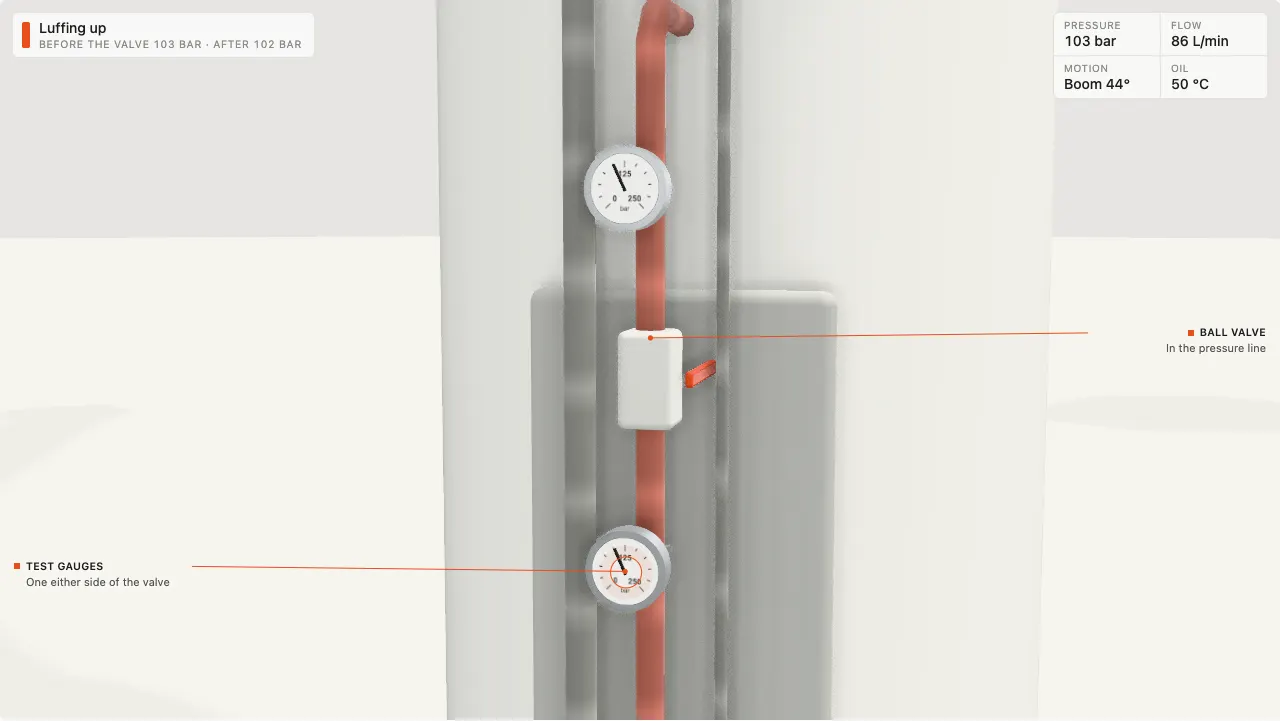
The two words engineers use most about hydraulics are pressure and flow, and they get mixed up all the time. A pump does not make pressure. It makes flow. Pressure appears only when something resists that flow: the load on a cylinder, or a valve, hose or blockage the oil has to squeeze through. The animation has a gauge either side of a needle valve so you can watch both effects separately.
In simple terms
Think of a garden hose. The tap decides how much water comes out each second: that is flow. Put your thumb over the end and the water pushes harder against your thumb: that is pressure. Your thumb didn’t make more water, it made the water work harder to get out.
In a hydraulic machine:
- Flow sets the speed. The pump pushes out a fixed amount of oil every turn. Send 30 litres a minute into a cylinder and it moves at a speed set by that flow and the cylinder’s size. Try the flow slider: the speed changes, the pressure barely does.
- The load sets the pressure. The oil pushes only as hard as it needs to lift what’s on the cylinder. Try the load slider: the pressure changes, the speed doesn’t.
- A restriction adds pressure before it. Close the needle valve and the gauge before the valve climbs while the gauge after it stays where the load put it. The pump now pushes harder than the load needs. That extra push is wasted and turns into heat in the valve.
- No flow, no difference. Press Stop. The oil stops moving and both gauges read the same. A restriction only creates a pressure difference while oil is flowing through it.
The relief valve is the limit. If the pump would need more pressure than the relief setting to push the oil through, the relief opens, some oil goes back to the tank and the machine slows. That’s what happens with the “partly blocked line” fault, or if the relief is set too low for the load.
- Play with it: A pump, a needle valve and a lifting cylinder, with a gauge either side of the valve.
- Break it: a partly blocked line (high pump pressure, hot fitting) and a relief set too low.
Sign in to read the rest of this lesson
Continue reading
Save your progress, open all 115 lessons and get a Course completed card when you finish.
or use your email
In the rest of this lesson
- Interactive animation: Pressure, flow and a needle valve
- For engineers
- Deep dive
- Key numbers
- 4 questions people ask
- Quiz: 4 questions
- Ask our engineers about this lesson
Familiarisation training from Al Safwan Academy. Finishing a course shows completion of online familiarisation training: it is not an STCW, flag-approved or manufacturer qualification, and these courses don't replace that training. The manufacturer's manual and your flag's rules always come first.