Lesson 17 · 7 min
Where hydraulic heat comes from, and why the oil overheats
Every kilowatt the motor puts in that doesn't do useful work ends up as heat in the oil. The oil settles at the temperature where the cooler and tank get rid of heat as fast as the system makes it.
Start here
The 2-minute primer
New to this? These 6 cards explain the lesson in plain words. Go through them first and the lesson will make sense.
Primer done.
-
1/6Picture this
A bath with the plug pulled out
Run a bath with the plug out. The water level rises until the water draining away equals the water coming in, then it stays put. Open the tap more, or block the drain, and it settles higher.
Oil temperature works the same way. It rises until the heat leaving equals the heat going in.
-
2/6The big idea
Wasted power becomes hot oil
Every bit of power the motor puts in that doesn’t do useful work turns into heat, and nearly all of it ends up in the oil.
The oil settles at the temperature where the cooler and the tank get rid of heat as fast as the system makes it. More waste, hotter air or a dusty cooler, and it settles hotter.
-
3/6Words you'll meet
Five words, in plain English
- Relief valve
- a safety valve that lets oil escape to the tank when pressure gets too high. Oil going over it becomes heat.
- Internal leakage
- oil slipping past worn parts from high pressure back to the tank, making heat on the way.
- Oil cooler
- a radiator with fins and a fan that blows air through to take heat out of the oil.
- Kilowatt
- a unit of power, used here to count both the useful work and the wasted heat.
- End of stroke
- when a cylinder is fully out or in and can’t move any further.
-
4/6Why it matters
Hot oil wears everything faster
Hot oil goes thin, so the machine leaks more and slows down. Operators then hold the lever longer, which makes even more heat. Oil breaks down into sludge and seals harden and crack.
Holding a lever at the end of stroke is the most common cause: the machine does nothing, but all the pump’s power goes into the oil.
-
5/6In this lesson
What you’ll be able to do
- Follow where the power goes, from motor to useful work.
- Know why a lever held at the end of stroke heats the oil fast.
- Explain why hot air and dusty coolers make oil run hotter.
- Find the part that is making the heat.
-
6/6Quick check
The machine does nothing, yet oil heats fast. Why?
Right: with nowhere else to go, all the pump’s oil goes over the relief valve, and all of its power becomes heat in the oil.
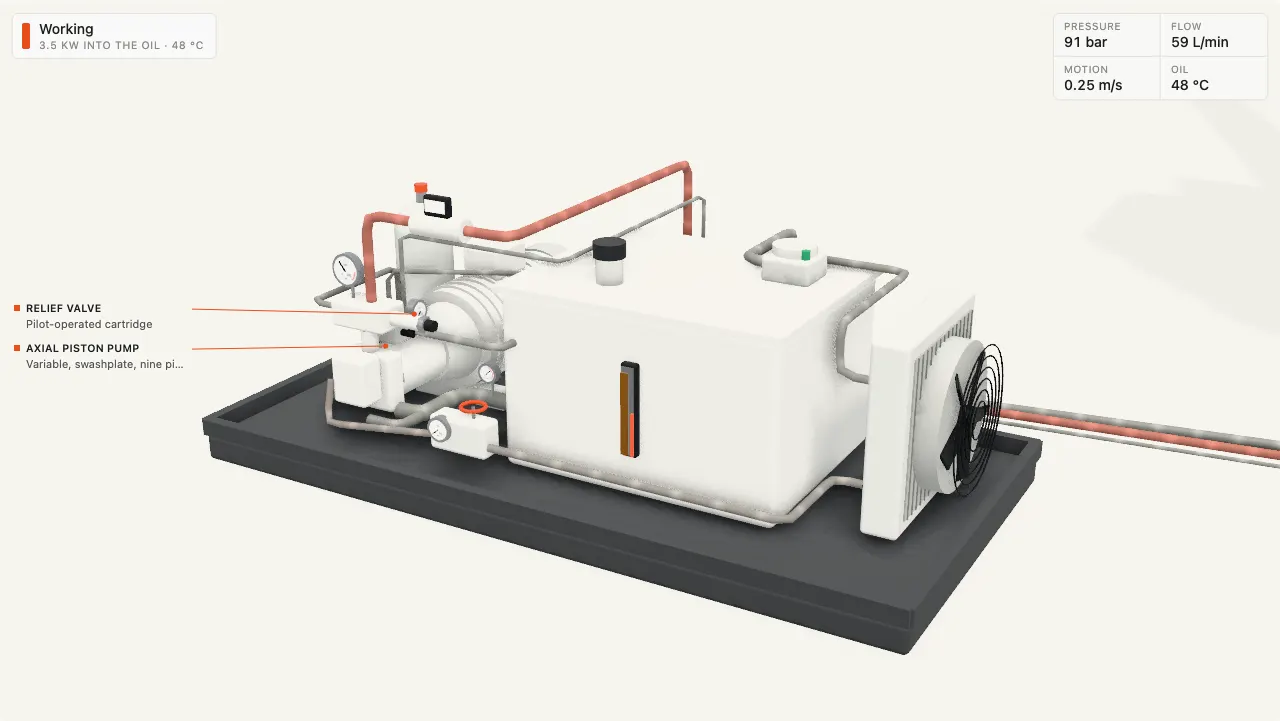
Hydraulic systems are not very efficient. A typical machine turns between a third and three quarters of the power it takes from the supply into useful work. The rest becomes heat, and nearly all of that heat ends up in the oil. Whether the oil runs at a comfortable 50 °C or a damaging 85 °C depends on two things you can explore above: how much power is wasted, and how well the system gets rid of it.
In simple terms
Follow the band in the diagram from left to right. It starts as the electric power the motor takes. The motor wastes a little, which warms the air around it. Then each part of the hydraulic system takes its share:
- The pump loses some power to friction and internal leakage.
- The relief valve, if oil is going over it, turns that oil’s whole pressure into heat.
- Valves and pipes need some pressure just to push the oil through them, and that pressure is lost as heat too.
Whatever is left at the end is the useful work: lifting, turning, pressing.
Now try “Held at end of stroke”. The machine is doing nothing, but the motor is still working hard, because all the pump’s oil is being forced over the relief valve. Every kilowatt goes into the oil. That is the most common reason a machine overheats.
The oil warms up until the heat leaving it equals the heat going in. The tank walls get rid of a little. A cooler, with a fan blowing air through fins, gets rid of much more. When the air around the machine is 45 or 50 °C, as on a UAE summer afternoon, the cooler has less temperature difference to work with, so everything settles hotter. Dust packing the fins makes it worse again.
- Play with it: Pump flow, load pressure, relief setting, air temperature and tank size, with oil temperature over time.
- Break it: a leaking relief valve, cooler fins blocked with dust, and a low oil level.
Sign in to read the rest of this lesson
Continue reading
Save your progress, open all 115 lessons and get a Course completed card when you finish.
or use your email
In the rest of this lesson
- Interactive animation: Energy flow from motor to work
- For engineers
- Deep dive
- Key numbers
- 4 questions people ask
- Quiz: 4 questions
- Ask our engineers about this lesson
Familiarisation training from Al Safwan Academy. Finishing a course shows completion of online familiarisation training: it is not an STCW, flag-approved or manufacturer qualification, and these courses don't replace that training. The manufacturer's manual and your flag's rules always come first.