Lesson 11 · 7 min
How a counterbalance valve stops a crane load running away
A counterbalance valve sits on the cylinder and holds the load until pilot pressure from the other side opens it just enough to let the oil out as fast as the pump fills the cylinder. The load comes down under control instead of falling.
Start here
The 2-minute primer
New to this? These 6 cards explain the lesson in plain words. Go through them first and the lesson will make sense.
Primer done.
-
1/6Picture this
Walking a heavy pushchair down a steep hill
Pushing a loaded pushchair uphill is hard work, but at least it only moves when you push. Going downhill is the tricky part. The pushchair wants to run away, so you hold it back and let it roll only as fast as you walk.
A crane boom coming down is that pushchair. Something has to hold it back.
-
2/6The big idea
A valve that holds back the load
A crane boom’s weight pushes on the oil in its cylinder all the time. Lifting is easy: the pump pushes against the load. Lowering is the hard part: now the load does the pushing and wants to fall.
A counterbalance valve sits on the cylinder and holds the boom. When you lower, it opens just enough to let oil out as fast as the pump fills the other side.
-
3/6Words you'll meet
Five words, in plain English
- Luffing cylinder
- the oil-filled ram that raises and lowers a crane’s boom.
- Pilot pressure
- a small pressure signal, taken from the other side of the cylinder, that helps push the valve open.
- Pilot ratio
- how strongly the pilot signal opens the valve. A high ratio opens it with very little signal.
- Setting
- the spring pressure the valve holds shut against, set above what the load makes.
- Cavitation
- the oil boiling into bubbles because one side is sucked into a vacuum, which damages seals.
-
4/6Why it matters
When the valve is missing or worn
Without the valve, the boom can drop faster than the pump can follow. A weak spring lets the load push the valve open, so the boom creeps or drops even with the lever in hold.
Dirt in the seat makes the boom drift, which fails a load test. A seized valve won’t lower at all, and cracking a fitting to free it releases the load with nothing holding it.
-
5/6In this lesson
What you’ll be able to do
- Explain how the valve holds a boom and lets it down under control.
- Know why its setting must stay above the pressure the load makes.
- Tell how a low or high pilot ratio changes the way a long boom behaves.
- Spot the signs of a weak, dirty or seized valve.
-
6/6Quick check
What does a counterbalance valve stop a boom doing?
Right: the valve holds the boom on its own and only lets oil out as fast as the pump fills the other side, so the load comes down at the speed asked for.
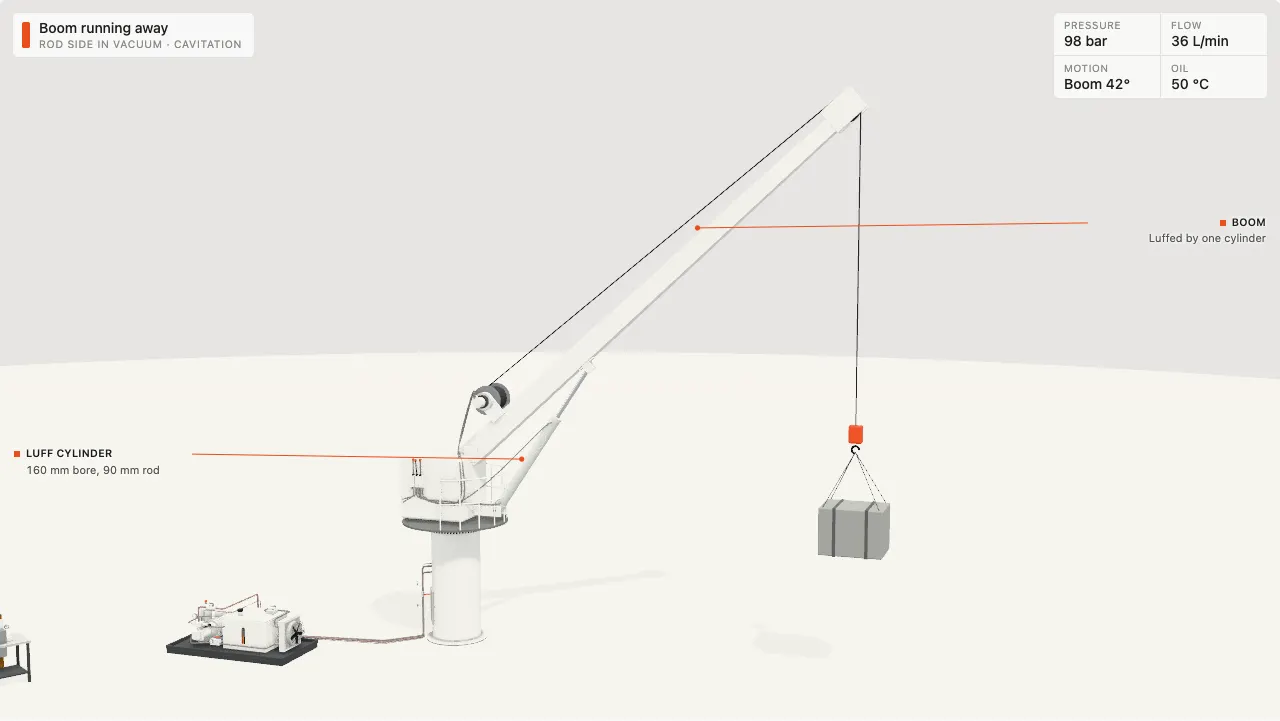
A crane boom wants to come down. Its weight, and the load on the hook, push oil out of the luffing cylinder all the time. Lift is easy: the pump pushes against the load. Lowering is the hard part, because now the load is doing the pushing, and without something to hold it back it falls faster than the pump can follow. The counterbalance valve is that something. In the animation, switch it off and lower the boom first. Then switch it back on.
In simple terms
Without the valve, opening the control valve to lower simply lets the oil out of the big side of the cylinder. The load pushes it out as fast as the pipes allow. The boom drops, and the pump, which is supposed to be filling the other side of the cylinder, can’t keep up. That side goes into a vacuum and the oil boils into bubbles. That’s cavitation, and it damages seals and makes the next movement jerky.
The counterbalance valve is mounted right on the cylinder, in the line from the big side. It is a spring-loaded valve set above the pressure the load makes, so it stays shut and holds the boom on its own. It has a pilot line from the other side of the cylinder. When you lower, the pump pressurises that side. That pressure, multiplied by the pilot ratio, adds to the load pressure and opens the valve, but only a little: just enough for the oil to leave as fast as the pump fills the other side. If the boom tries to go faster, the pressure on the pump side drops, the valve closes a little and slows it. The load comes down at the speed the operator asks for, whatever it weighs.
It does a second job too. Because it sits on the cylinder and holds the load by itself, a burst hose between the valve and the cab does not drop the boom.
- Play with it: Lower a crane boom with and without the valve, then change the setting and the pilot ratio.
- Break it: a weak spring (the boom drops), dirt holding it open (it drifts) and a seized valve (it won't lower).
Sign in to read the rest of this lesson
Continue reading
Save your progress, open all 115 lessons and get a Course completed card when you finish.
or use your email
In the rest of this lesson
- Interactive animation: Crane boom with and without a counterbalance valve
- For engineers
- Deep dive
- Key numbers
- 4 questions people ask
- Quiz: 4 questions
- Ask our engineers about this lesson
Familiarisation training from Al Safwan Academy. Finishing a course shows completion of online familiarisation training: it is not an STCW, flag-approved or manufacturer qualification, and these courses don't replace that training. The manufacturer's manual and your flag's rules always come first.