Lesson 18 · 7 min
Pump cavitation and aeration: why a hydraulic pump gets noisy
Cavitation is a pump starved of oil, so bubbles form at the inlet and implode on the pressure side. Aeration is air getting into the oil. Both make noise and both destroy pumps, but the fixes are different.
Start here
The 2-minute primer
New to this? These 6 cards explain the lesson in plain words. Go through them first and the lesson will make sense.
Primer done.
-
1/6Picture this
A thick milkshake through a thin straw
Try drinking a thick milkshake through a thin straw. You suck hard, little comes up, and bubbles form. Now try it with a split in the straw: you get a mouthful of air instead.
A hydraulic pump has both of these problems. The first is cavitation. The second is aeration.
-
2/6The big idea
Two noises, two different causes
A pump doesn’t really suck. It makes a space, and the air pressing on the oil in the tank pushes oil in. That push is only about 1 bar, and the pipe and strainer use some of it up.
Cavitation: too little push is left, bubbles form and then burst inside the pump. Aeration: air gets into the oil from outside.
-
3/6Words you'll meet
Five words, in plain English
- Suction line
- the pipe that carries oil from the tank to the pump.
- Strainer
- a coarse mesh on the suction side that stops large debris reaching the pump.
- Cavitation
- bubbles forming in a starved pump, then collapsing hard against the metal.
- Aeration
- outside air getting into the oil, making it milky and foamy.
- Vacuum
- pressure below that of the air around us, as inside the suction line.
-
4/6Why it matters
Both of them destroy pumps
Each collapsing bubble is a tiny hammer blow on the metal. Thousands a second pit the pump’s surfaces, and the debris wears everything downstream.
Aerated oil makes cylinders move in jerks because air squashes. The fixes are different, so knowing which one you have saves fitting a new pump that fails the same way.
-
5/6In this lesson
What you’ll be able to do
- Explain how oil really gets into a pump.
- Know the common causes of cavitation, from blocked strainers to cold oil.
- Find how air leaks into a suction line without a drip.
- Tell cavitation and aeration apart by sound, oil and gauge.
-
6/6Quick check
Why doesn’t a loose suction clamp drip oil?
Right: pressure inside the suction line is lower than outside, so the leak goes inwards and you only get bubbles and noise.
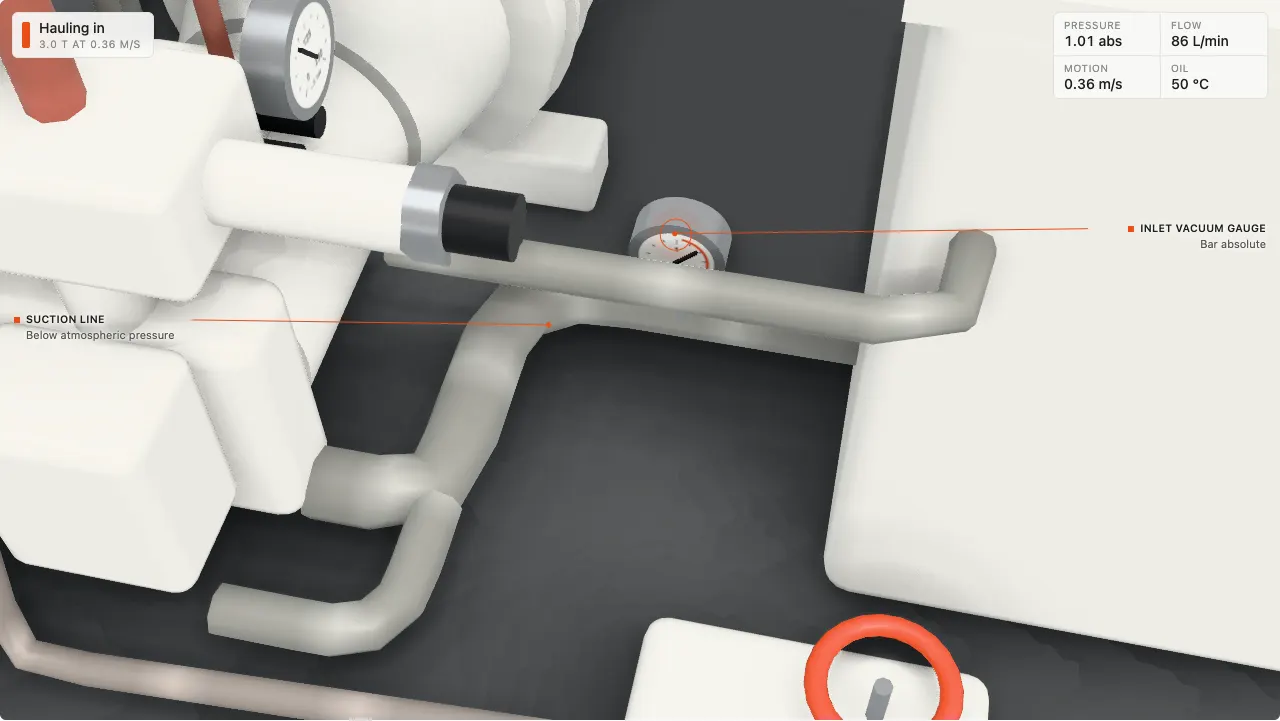
A healthy hydraulic pump hums. A pump that rattles like it is full of gravel, or whines and turns the oil milky, is telling you that something is wrong on its suction side, not usually inside the pump itself. The two classic causes, cavitation and aeration, sound similar and feel similar, but they come from opposite directions. Play with the suction line above and you will see why.
In simple terms
A pump doesn’t really suck oil. It makes a space, and the air pressure pushing down on the oil in the tank pushes oil into that space. That push is only about 1 bar, and everything between the tank and the pump uses some of it up: lifting the oil if the pump sits above the tank, dragging it through a long or thin pipe, forcing it through a strainer, and speeding it up into the pump.
Cavitation happens when too little of that push is left. The pressure at the pump inlet drops so low that bubbles form in the oil, from dissolved air and oil vapour. A moment later the pump carries those bubbles into the high-pressure side, where they are crushed and collapse. Each collapse is a tiny hammer blow against the metal. Thousands of them a second make the gravel rattle and pit the pump’s surfaces.
Common causes: a blocked strainer, a suction line that is too thin or too long, cold thick oil, a pump running too fast, or a pump mounted above the oil.
Aeration is air getting into the oil from outside. The suction line is below atmospheric pressure, so a loose fitting or a cracked hose there doesn’t leak oil, it sucks air in. You won’t see a drip. Air also gets in when a return line ends above the oil surface and splashes. The bubbles go round the circuit, the oil turns milky and foams, the pump whines, and cylinders move in jerks because air squashes.
- Play with it: Suction bore and length, oil temperature, tank level and pump speed, with a live inlet vacuum gauge.
- Break it: a clogged suction strainer, an air leak at a suction fitting, and a return line splashing above the oil.
Sign in to read the rest of this lesson
Continue reading
Save your progress, open all 115 lessons and get a Course completed card when you finish.
or use your email
In the rest of this lesson
- Interactive animation: Suction line, pump and tank
- For engineers
- Deep dive
- Key numbers
- 4 questions people ask
- Quiz: 4 questions
- Ask our engineers about this lesson
Familiarisation training from Al Safwan Academy. Finishing a course shows completion of online familiarisation training: it is not an STCW, flag-approved or manufacturer qualification, and these courses don't replace that training. The manufacturer's manual and your flag's rules always come first.