Lesson 15 · 6 min
Hydraulic contamination: particles, clearances and filters
Most hydraulic failures start with dirt. Particles the size of a valve's clearance jam and score it, so the filter has to catch them, and the oil cleanliness code tells you whether it does.
Start here
The 2-minute primer
New to this? These 6 cards explain the lesson in plain words. Go through them first and the lesson will make sense.
Primer done.
-
1/6Picture this
Grit in a sliding window track
A sliding window runs smoothly until grit gets into its track. Fine dust blows straight through. A pebble can’t get in at all. But a grain the same size as the gap wedges in, jams the window and scratches the rail.
Inside a hydraulic valve the same thing happens, only the gaps are far too small to see.
-
2/6The big idea
Most failures start with tiny dirt
Moving parts in pumps and valves are separated by gaps of a few microns. The dangerous particles are the ones about the size of the gap. They jam valves and scratch metal, the gap grows, and wear feeds itself.
A filter catches these particles before they reach the valves. Keeping dirt out in the first place matters just as much.
-
3/6Words you'll meet
Six words, in plain English
- Micron
- a thousandth of a millimetre. A human hair is about 70 microns thick.
- Clearance
- the tiny gap between two moving parts, such as a valve spool and its body.
- Filter element
- the replaceable part of a filter that traps the dirt.
- Bypass valve
- a small valve that sends oil round a blocked filter element, unfiltered.
- Breather
- the vent on the tank that lets air in and out as the oil level changes.
- ISO 4406 code
- three numbers, like 18/16/13, that count particles in an oil sample. Lower is cleaner.
-
4/6Why it matters
Dirt you can’t see costs the most
Dirt wears pumps, scores valve spools and makes valves stick. A blocked filter quietly opens its bypass, and from then on the dirt goes round the whole system.
Most dirt comes in from outside: through the tank breather, past worn rod seals and during repairs. In a dusty yard, a missing breather cap can put more dirt in a week than the system makes in a year.
-
5/6In this lesson
What you’ll be able to do
- Know which particle sizes do the most harm, and why.
- Read an ISO 4406 cleanliness code.
- Tell what a filter’s bypass and clogging indicator are telling you.
- Spot where dirt gets in, and how to keep it out.
-
6/6Quick check
Which particles harm a valve the most?
Right: small ones float through and big ones can’t get in. Particles near the gap size wedge in, jam the part and scratch the metal.
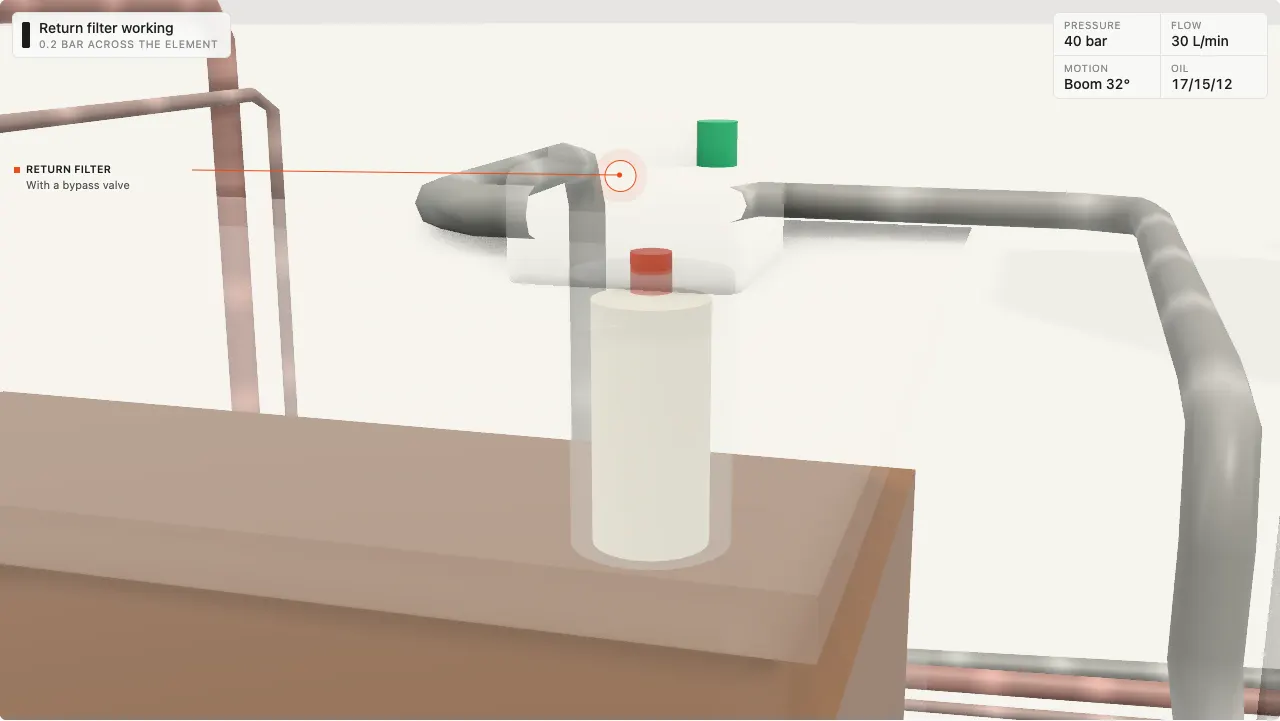
Engineers who look after hydraulic systems for long enough all say the same thing: most failures start with dirt. Not big, visible dirt, but particles of a few microns, far too small to see, that wear pumps, score valve spools and make valves stick. This lesson zooms into a valve clearance and shows what those particles do, and how a filter, a breather and a cleanliness code keep them under control.
In simple terms
Inside a pump or valve, moving parts are separated by gaps measured in microns (thousandths of a millimetre). A human hair is about 70 microns thick. The gap around a valve spool may be 5 to 15 microns.
Dirt particles that are much smaller than the gap float straight through. Particles much bigger can’t get in. The dangerous ones are those about the size of the gap: they wedge in, jam the spool, or get dragged through and scratch the metal. Scratches make the gap bigger, the valve leaks more, and the new, bigger gap lets in bigger particles. Wear feeds itself.
The filter catches particles before they reach the valves. A finer filter catches smaller ones. When an element fills with dirt, oil struggles to get through it, so a small bypass valve opens and sends the oil around it. That protects the filter from bursting, but the oil now goes round unfiltered. A clogging indicator tells you before that happens.
Most dirt comes in from outside: through the tank breather every time the oil level drops, past worn rod seals, and during repairs. In a dusty UAE yard a missing breather cap can put more dirt in a week than the system makes in a year.
The ISO 4406 code, three numbers like 18/16/13, counts particles in a sample of oil at three sizes. Each step of one number means twice as many particles. Lower is cleaner.
- Play with it: Pick a filter, set a valve clearance, read the live ISO 4406 code, and watch particles pass, scrape or jam.
- Break it: a clogged element opening its bypass, and a missing breather cap letting dust in.
Sign in to read the rest of this lesson
Continue reading
Save your progress, open all 115 lessons and get a Course completed card when you finish.
or use your email
In the rest of this lesson
- Interactive animation: Particles, filters and a spool clearance
- For engineers
- Deep dive
- Key numbers
- 4 questions people ask
- Quiz: 4 questions
- Ask our engineers about this lesson
Familiarisation training from Al Safwan Academy. Finishing a course shows completion of online familiarisation training: it is not an STCW, flag-approved or manufacturer qualification, and these courses don't replace that training. The manufacturer's manual and your flag's rules always come first.