Lesson 8 · 7 min
How a hydraulic relief valve works: direct-acting and pilot-operated
A relief valve is a spring holding a poppet shut. When pressure times seat area beats the spring, it opens and sends oil back to tank, which caps the system pressure and turns that flow into heat.
Start here
The 2-minute primer
New to this? These 6 cards explain the lesson in plain words. Go through them first and the lesson will make sense.
Primer done.
-
1/6Picture this
The safety valve on a pressure cooker
A pressure cooker has a small valve on its lid. While the pressure inside is safe, it stays shut. When the pressure gets too high, it lifts and lets steam out, so the pot never bursts.
But all that escaping steam is energy you paid for and never used. A relief valve does the same job, with oil instead of steam.
-
2/6The big idea
A spring that waits for its limit
Inside the valve, a cone-shaped poppet is held shut by a spring. Screw the adjuster in and the spring presses harder, so the oil needs more pressure to push it open.
Most of the time it does nothing at all. When pressure reaches the setting, it opens just enough to send oil back to the tank, and the pressure stops climbing.
-
3/6Words you'll meet
Six words, in plain English
- Poppet
- a cone-shaped plug that sits in a hole and seals it.
- Cracking pressure
- the pressure at which the valve first starts to open and let oil through.
- Override
- the extra pressure needed after cracking to open the valve wide enough for the full flow.
- Direct-acting
- a simple relief valve where one spring alone holds the poppet shut.
- Pilot-operated
- a relief valve where a tiny pilot poppet controls a bigger main spool, so pressure stays steadier.
- Dead-head
- block the oil’s path completely, for example with a cylinder at the end of its stroke.
-
4/6Why it matters
Too low or too high both cost
Set too low, the machine lacks force and cooks its own oil. Oil going over the valve at full pressure does no work, so it all becomes heat.
Set too high, or stuck shut, and nothing protects the hoses: the next pressure spike finds the weakest one. Dirt on the seat makes a valve leak, hiss and run hot.
-
5/6In this lesson
What you’ll be able to do
- Explain how a spring and a poppet put a cap on pressure.
- Tell a direct-acting valve from a pilot-operated one.
- Know how a relief valve should be set and locked.
- Spot a weak spring, a dirty seat or a blocked pilot orifice.
-
6/6Quick check
What does oil over a relief valve become?
Right: oil forced through the valve does no work, so its energy turns into heat, like a small heater running inside the tank.
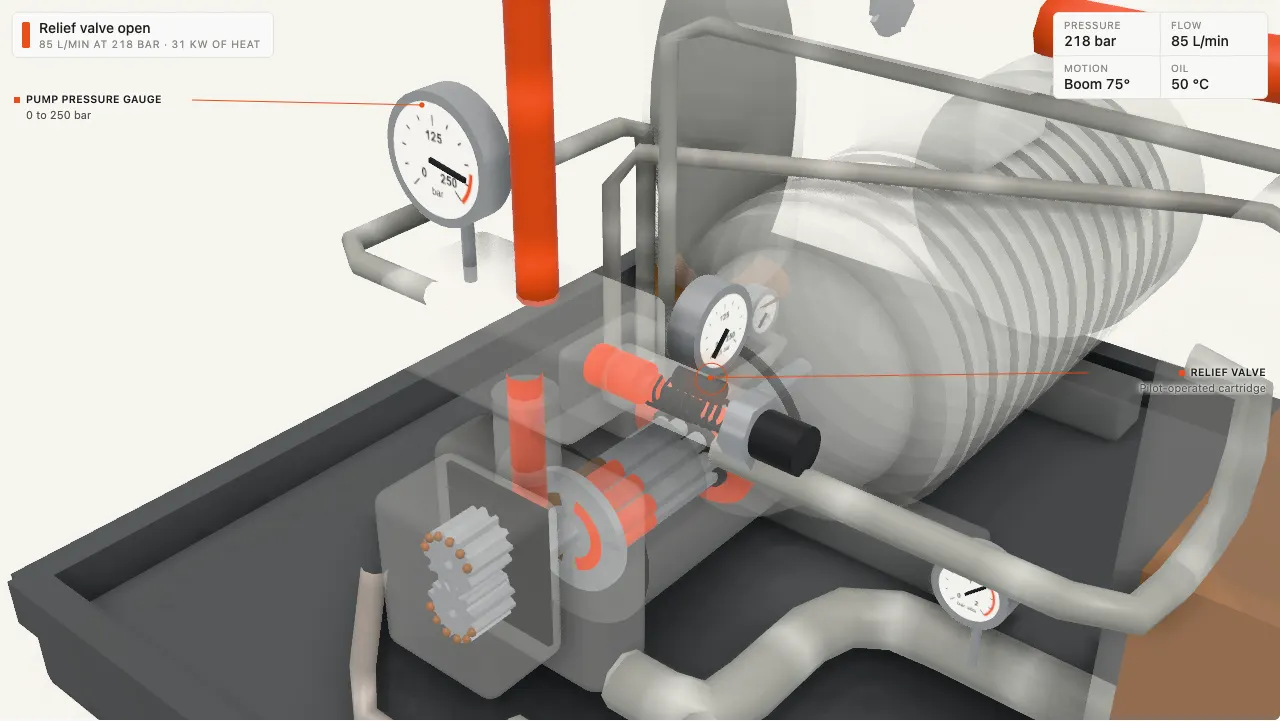
Every hydraulic system has a relief valve, and most of the time it does nothing at all. It waits, shut, until the pressure reaches the limit it is set for, then opens just enough to stop it going any higher. Get the setting or the valve wrong and you get either a machine with no power, a machine that cooks its own oil, or one with nothing protecting its hoses. Turn the adjuster in the animation, push the load past the setting and watch the curve on the right.
In simple terms
Inside the valve a cone-shaped poppet sits in a hole, held shut by a spring. Oil from the pump pushes on the small area of the poppet that sits over the hole. Screwing the adjuster in squeezes the spring harder, so the oil needs more pressure to push the poppet back.
While the load needs less than the setting, the valve stays shut and every drop of oil goes to the work. When the load needs more, for example when a cylinder reaches the end of its stroke or a crane tries to lift too much, pressure rises until it can push the poppet open. Oil then runs straight back to the tank and the pressure stops climbing. Nothing bursts.
There’s a catch. Oil forced through the valve at full pressure does no work, so its energy becomes heat. Look at the heat readout when the valve is passing all the pump’s flow: several kilowatts, the same as a small electric heater running inside your oil tank.
The valve also doesn’t open like a light switch. It starts to lift at its setting (it “cracks”), then needs more pressure to open wider and pass the full flow. On a simple direct-acting valve that difference is typically 10 to 25% of the setting: 16 to 40 bar at the 160 bar default above. A pilot-operated valve, the second option in the animation, uses a tiny pilot poppet to control a big main spool, so its curve is much flatter.
- Play with it: Turn the adjuster, raise the load and flow, and switch between direct-acting and pilot-operated valves.
- Break it: a weak spring, dirt on the seat, and a blocked pilot orifice.
Sign in to read the rest of this lesson
Continue reading
Save your progress, open all 115 lessons and get a Course completed card when you finish.
or use your email
In the rest of this lesson
- Interactive animation: Relief valve cutaway and its pressure–flow curve
- For engineers
- Deep dive
- Key numbers
- 4 questions people ask
- Quiz: 4 questions
- Ask our engineers about this lesson
Familiarisation training from Al Safwan Academy. Finishing a course shows completion of online familiarisation training: it is not an STCW, flag-approved or manufacturer qualification, and these courses don't replace that training. The manufacturer's manual and your flag's rules always come first.