Lesson 6 · 7 min
How a hydraulic gear pump works, and why it wears
Two meshing gears carry oil round the outside of the housing in the spaces between their teeth, and the mesh in the middle squeezes it out. Every turn moves the same volume, so flow follows speed.
Start here
The 2-minute primer
New to this? These 6 cards explain the lesson in plain words. Go through them first and the lesson will make sense.
Primer done.
-
1/6Picture this
A revolving door for oil
A revolving door carries people round in little pockets. You step in on one side, the door turns, and you step out on the other. Nobody walks straight through the middle.
A gear pump works the same way. The spaces between the gear teeth carry pockets of oil round the outside, from the inlet to the outlet.
-
2/6The big idea
Every turn moves the same oil
Two gears mesh together inside a tight housing. As they turn, oil fills the tooth spaces at the inlet and is carried round the outside. Where the teeth mesh in the middle there is no room, so the oil is squeezed out.
Every turn moves the same amount. Double the speed and you double the flow.
-
3/6Words you'll meet
Six words, in plain English
- Gear pump
- a pump with two meshing gears inside, the most common hydraulic pump in the world.
- Inlet and outlet
- where oil comes into the pump from the tank, and where it is pushed out.
- Internal leakage
- oil slipping back inside the pump from the high-pressure side to the low side.
- Side plates
- plates pressed against the sides of the gears to keep the gaps there small.
- Strainer
- a mesh on the suction side that stops large bits reaching the pump.
- Cavitation
- bubbles forming when the pump can’t fill properly, then collapsing hard and eating the metal.
-
4/6Why it matters
A worn pump fails when working hard
A little oil always slips back inside the pump, and more slips back as pressure rises. A worn pump can lose a third of its flow at full pressure.
So the machine seems fine with a light load, then goes slow and hot when it works hard. A blocked inlet is worse: the pump rattles like gravel and wears itself away.
-
5/6In this lesson
What you’ll be able to do
- Follow the oil’s path round the outside of the gears.
- Work out a pump’s flow from its size and speed.
- Spot a worn pump from how its flow falls under pressure.
- Recognise the sound and the causes of cavitation.
-
6/6Quick check
You double a gear pump’s speed. What happens?
Right: every turn moves the same amount of oil, so twice the turns means twice the flow. Pressure still comes from the load.
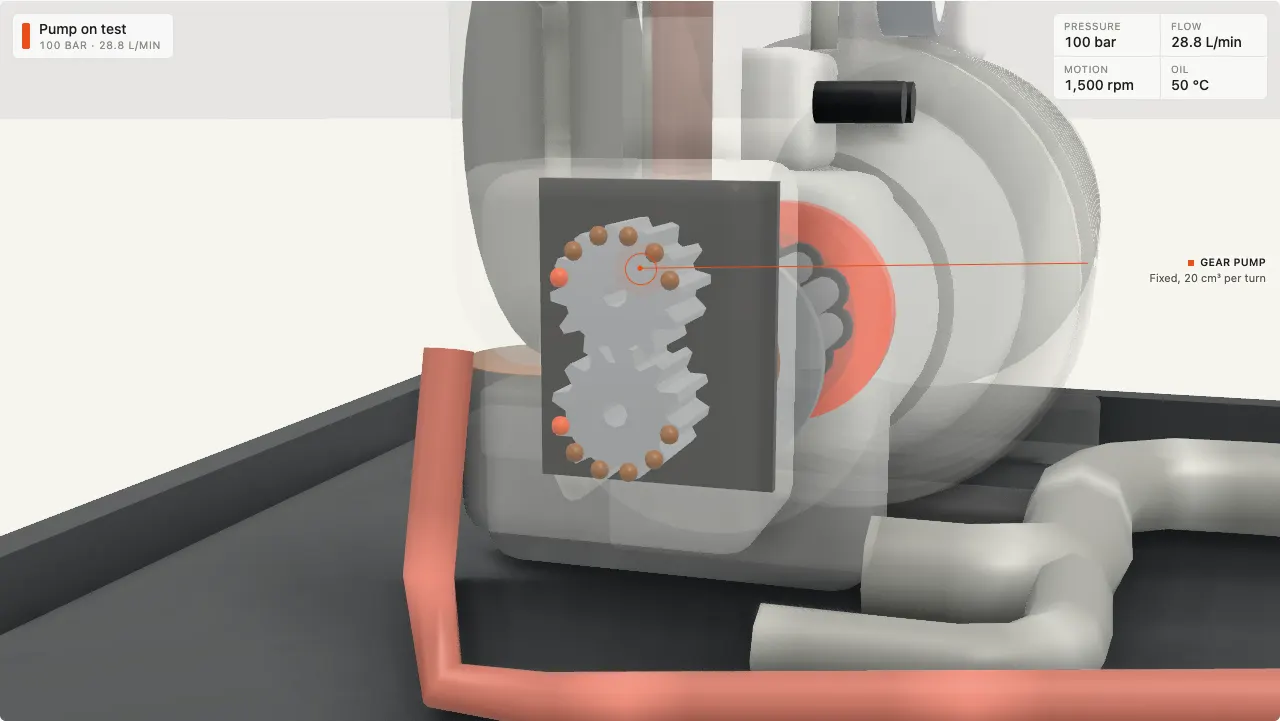
The external gear pump is the most common hydraulic pump in the world. It drives tipper bodies, small cranes, power packs, steering on plant and the auxiliaries on almost every vessel. It has two moving parts, it tolerates dirt better than most pumps, and when it wears it tells you in a predictable way. Spin it up in the animation, then raise the pressure and watch what happens to the flow.
In simple terms
Look at the orange and grey dots in the tooth spaces. As the gears turn, each space between two teeth opens up at the bottom, where the inlet is. Oil from the tank flows in to fill it. The gear then carries that pocket of oil round the outside of the housing, sealed in by the tight fit of the teeth against the wall, up to the outlet.
In the middle, where the two gears mesh, the teeth push into each other’s spaces. There is no room for the oil there, so it is squeezed out of the outlet. Oil never goes through the middle of the pump. It always goes round the outside.
Because every turn moves the same amount of oil, flow depends on how big the pump is and how fast it turns. Double the speed and you double the flow. Pressure is set by the load the oil is pushing, as in lesson 2, and the pump just has to be strong enough to deliver against it.
No pump is perfectly sealed. A little oil always slips back from the high-pressure outlet to the inlet across the sides of the gears. The higher the pressure, the more slips back. A new pump loses only a few percent. A worn one can lose a third of its flow at full pressure, which is why a machine with a worn gear pump works fine when it’s lightly loaded and goes slow when it works hard.
- Play with it: Spin the gears, change speed, displacement and pressure, and watch flow and efficiency.
- Break it: worn side plates (flow falls as pressure rises) and a clogged suction strainer.
Sign in to read the rest of this lesson
Continue reading
Save your progress, open all 115 lessons and get a Course completed card when you finish.
or use your email
In the rest of this lesson
- Interactive animation: External gear pump, cut open
- For engineers
- Deep dive
- Key numbers
- 4 questions people ask
- Quiz: 4 questions
- Ask our engineers about this lesson
Familiarisation training from Al Safwan Academy. Finishing a course shows completion of online familiarisation training: it is not an STCW, flag-approved or manufacturer qualification, and these courses don't replace that training. The manufacturer's manual and your flag's rules always come first.