Lesson 13 · 7 min
Hydraulic motors and winches: how flow makes speed and pressure makes torque
A hydraulic motor is a pump run backwards: oil flow turns it, and the pressure needed rises with the torque the load demands. On a winch a spring-applied brake holds the load whenever the oil is off.
Start here
The 2-minute primer
New to this? These 6 cards explain the lesson in plain words. Go through them first and the lesson will make sense.
Primer done.
-
1/6Picture this
An old water mill by a stream
Picture a water mill. Water pours onto the wheel and turns it. More water each minute turns it faster. A heavier millstone to grind means the water has to push harder.
A hydraulic motor is a sealed water mill. Oil flows through it and turns the shaft that winds in an anchor chain or a mooring rope.
-
2/6The big idea
Flow turns it, pressure makes it strong
A hydraulic motor is a pump working the other way round. Every turn swallows a fixed amount of oil, so more oil per minute means more turns per minute.
The heavier the load, the more pressure it needs. On a winch, a gearbox and the drum turn that twisting force into pull on the rope. And a spring brake, not the oil, holds the load when you stop.
-
3/6Words you'll meet
Five words, in plain English
- Torque
- twisting force, how hard the shaft turns.
- Displacement
- how much oil the motor swallows for each turn, measured in cubic centimetres.
- Drum
- the round barrel the rope or wire winds onto.
- Spring-applied brake
- a brake clamped on by springs and only released by oil pressure.
- Brake valve
- a valve that holds back a load paying out, so it can’t run away. It works like a counterbalance valve.
-
4/6Why it matters
A motor alone can’t hold a load
Hydraulic motors always leak a little inside. A worn one leaks more as the load gets heavier, so it slows down just when the work is hardest, and can even turn backwards and let the load slip.
A brake that doesn’t release fully drags, overheats and wastes power. Knowing what does what tells you where to look first.
-
5/6In this lesson
What you’ll be able to do
- Explain how flow sets speed and pressure sets pull.
- Know how motor size and drum size trade pull against speed.
- Tell why the brake, not the oil, must hold the load.
- Spot a worn motor and a dragging brake.
-
6/6Quick check
The power pack stops. What holds the load?
Right: when the pressure drops, the springs clamp the brake on. A motor always leaks a little, so it can’t hold a load by itself.
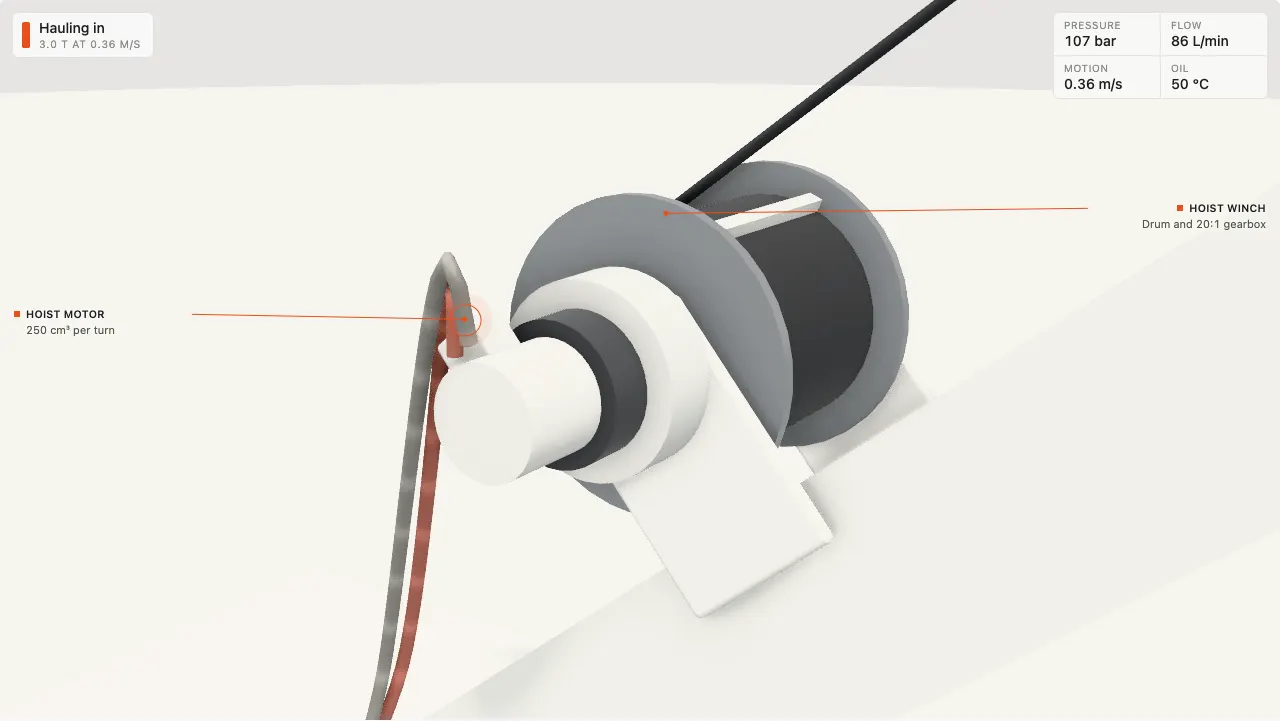
Anchor windlasses, mooring winches, towing winches, crane hoists, slewing drives, capstans and conveyors all turn hydraulic flow into rotation with a hydraulic motor. The relationships are the same as for a cylinder, just round instead of straight: flow decides how fast it turns, pressure decides how hard. Haul the load in the animation, then make it heavier, change the motor and the drum, and break something.
In simple terms
A hydraulic motor looks and works much like a pump, but the other way round. Oil is pushed into it, and the oil pushing on its pistons or gears turns the shaft. Every turn swallows a fixed amount of oil, so more oil per minute means more turns per minute. A motor that takes 400 cm³ per turn, fed 60 litres a minute, turns 150 times a minute.
How hard it turns depends on the pressure. The heavier the load on the rope, the more pressure the motor needs. A bigger motor (more cm³ per turn) gives more turning force from the same pressure, but turns slower on the same flow. It’s the same trade as the jack in lesson 1: force against speed.
The drum turns that twisting force into pull on the rope. A small drum gives more pull and less rope speed. A big drum gives more speed and less pull. Most winches also have a gearbox between motor and drum to multiply the torque.
The brake is the safety part. It’s held on by strong springs and only released by oil pressure. When the lever is in the middle, or the power pack stops, or a hose bursts, the pressure drops and the springs clamp the brake on. The brake holds the load, not the oil.
When you pay out, the load wants to fall and drives the motor round. A brake valve (a kind of counterbalance valve, lesson 11) holds it back so the load can only come down as fast as the pump fills the motor. The energy of the falling load turns into heat in that valve.
- Play with it: Haul, stop and pay out a load; change motor size and drum diameter and watch pull and speed.
- Break it: a worn motor (slow, then the load slips back) and a brake that drags.
Sign in to read the rest of this lesson
Continue reading
Save your progress, open all 115 lessons and get a Course completed card when you finish.
or use your email
In the rest of this lesson
- Interactive animation: Hydraulic winch: motor, brake, gearbox, drum
- For engineers
- Deep dive
- Key numbers
- 4 questions people ask
- Quiz: 4 questions
- Ask our engineers about this lesson
Familiarisation training from Al Safwan Academy. Finishing a course shows completion of online familiarisation training: it is not an STCW, flag-approved or manufacturer qualification, and these courses don't replace that training. The manufacturer's manual and your flag's rules always come first.