Lesson 19 · 9 min
How ship steering gear works: rams, the Rapson slide and two pump units
Pumps push oil into rams, the rams push a crosshead along the tiller, and the tiller turns the rudder stock. Follow-up control stops the rudder at the helm order, and locking valves hold it there against the water.
Start here
The 2-minute primer
New to this? These 6 cards explain the lesson in plain words. Go through them first and the lesson will make sense.
Primer done.
-
1/6Picture this
Holding a heavy gate open in the wind
Imagine holding a heavy garden gate open on a windy day. The wind keeps pushing it shut, and the wider you open it, the harder it pushes. You need strong arms to move it, and a latch to hold it once it’s where you want.
A ship’s rudder is that gate, and the water is the wind.
-
2/6The big idea
Push the tiller, hold the rudder
The rudder turns on a vertical shaft. On top of it is an arm, the tiller. Thick steel plungers called rams, driven by oil, push the tiller across.
When the bridge moves the helm, the gear turns the rudder until it matches the order. Then valves lock the oil in, so the rudder stays put while the water pushes against it.
-
3/6Words you'll meet
Six words, in plain English
- Rudder stock
- the vertical shaft the rudder turns on.
- Ram
- a thick steel plunger in an oil-filled cylinder that pushes the tiller.
- Rapson slide
- a sliding block linking ram and tiller, so a straight push turns the rudder.
- Follow-up
- the control that compares the ordered angle with the real angle and stops the rudder when they match.
- Locking valves
- valves that trap the oil so the rudder holds its angle.
- SOLAS
- Safety of Life at Sea, the international rules for ship safety, including a steering gear timing test.
-
4/6Why it matters
Quick in harbour, slow at sea
Steering gear is the hydraulic machine a ship can least afford to lose. A worn pump slows down most when the water pushes hardest, so gear that is quick in harbour can be slow at sea.
Air in the oil makes the rudder lag and overshoot. A leaking valve lets the water push the rudder back, so it wanders off course.
-
5/6In this lesson
What you’ll be able to do
- Follow how oil, rams and tiller turn the rudder.
- Know what the timing test asks for, and why it is done at speed.
- Tell how a four-ram gear keeps steering after a seal fails.
- Spot the causes of slow, hunting or drifting steering.
-
6/6Quick check
Why are there two pump units on steering gear?
Right: each pump unit alone must be able to steer the ship, so losing one does not leave the ship without steering.
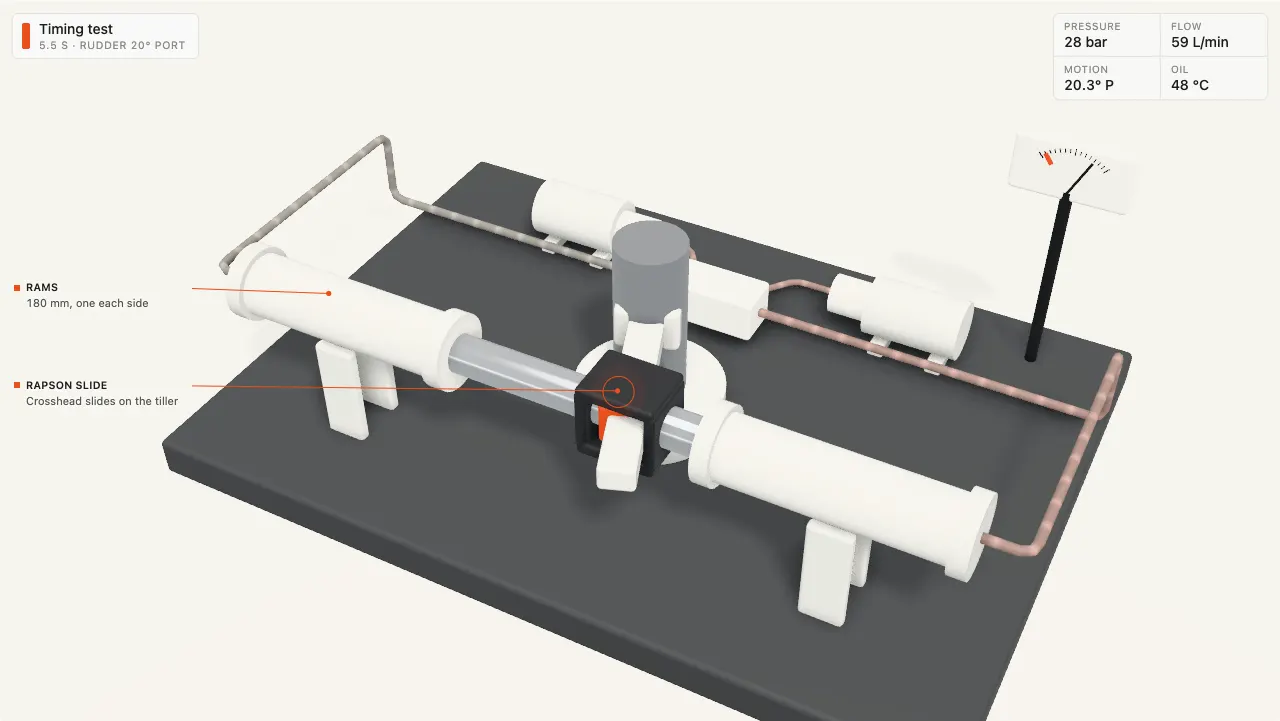
Steering gear is the hydraulic machine a ship can least afford to lose. Its job sounds simple: turn the rudder to the angle the bridge orders and hold it there, whatever the sea does. In the animation, drag the orange pointer on the rudder angle indicator (or use the helm slider), then run the SOLAS timing test. Try it at full speed with a worn pump, and again with the ship stopped.
In simple terms
The rudder sits under the stern on a vertical shaft, the rudder stock. On top of the stock, in the steering gear room, is an arm called the tiller. Push the end of the tiller sideways and the rudder turns.
The pushing is done by rams: thick steel plungers in cylinders full of oil. On a two-ram gear there is one pair, lined up across the ship, one ram each side of the tiller. Pump oil into one cylinder and its ram pushes the tiller across, while the ram on the other side is pushed back into its cylinder and its oil goes back to the tank.
The ram can’t push the tiller directly because the tiller swings in an arc while the ram moves in a straight line. So the ram drives a block, the crosshead, that slides along the tiller. This is the Rapson slide. Watch it in the animation: as the rudder angle grows, the crosshead slides further out along the tiller.
Two independent pump units supply the oil. Each one alone must be able to steer the ship. When the helm is moved, the follow-up control compares the order with the actual rudder angle and opens the valve until they match. Then the locking valves shut and trap the oil, so the rudder holds its angle while the pump idles.
The water is the load. At speed, the flow over the rudder tries to push it back to midships, and the further it is turned, the harder the water pushes. That is why the ram pressure rises with speed and angle, and why a gear that is quick alongside in harbour can be slow at sea.
- Play with it: Steer from the helm, change ship speed and gear type, and run the SOLAS timing test against the clock.
- Break it: a worn pump, air in the oil, a leaking locking valve and a failed ram seal.
Sign in to read the rest of this lesson
Continue reading
Save your progress, open all 115 lessons and get a Course completed card when you finish.
or use your email
In the rest of this lesson
- Interactive animation: Ram steering gear with a Rapson slide
- For engineers
- Deep dive
- Key numbers
- 4 questions people ask
- Quiz: 4 questions
- Ask our engineers about this lesson
Familiarisation training from Al Safwan Academy. Finishing a course shows completion of online familiarisation training: it is not an STCW, flag-approved or manufacturer qualification, and these courses don't replace that training. The manufacturer's manual and your flag's rules always come first.