Lesson 7 · 7 min
How an axial piston pump works: the swashplate, the valve plate and the case drain
Pistons in a rotating barrel slide on a tilted swashplate, so each one draws oil in for half a turn and pushes it out for the other half. Change the tilt and you change the flow without changing the speed.
Start here
The 2-minute primer
New to this? These 6 cards explain the lesson in plain words. Go through them first and the lesson will make sense.
Primer done.
-
1/6Picture this
A carousel on a sloping track
On a carousel, the horses rise and fall as the ride turns. Imagine that rise and fall came from a sloping track underneath them.
Make the slope steeper and the horses go up and down further. Make the track flat and they just go round, level, even though the ride keeps turning. A piston pump works on exactly that idea.
-
2/6The big idea
Tilt the plate, change the flow
Inside the pump, nine pistons sit in holes in a spinning block called the barrel. Their feet slide on a tilted plate, the swashplate. Each piston draws oil in for half a turn and pushes it out for the other half.
Tilt the plate further and each piston moves further, so more oil comes out. The speed never has to change.
-
3/6Words you'll meet
Five words, in plain English
- Swashplate
- the tilting plate the pistons’ feet slide on. Its angle sets how much oil comes out.
- Barrel
- the round block, turned by the drive shaft, with a piston in each of its holes.
- Valve plate
- the plate behind the barrel with two curved slots that let oil in and out.
- Case drain
- a separate pipe that takes oil leaked inside the pump back to the tank.
- Shaft seal
- the seal where the drive shaft leaves the pump, able to take only low pressure.
-
4/6Why it matters
The drain tells you the pump’s health
A little leakage is on purpose: it lubricates the pistons and the valve plate. As the pump wears, more oil leaks and the case drain flow goes up. Measuring it is the quickest health check without opening the pump.
The drain line matters too. If it is blocked or badly routed, pressure builds inside the pump and pushes the shaft seal out.
-
5/6In this lesson
What you’ll be able to do
- Explain how a tilted plate makes the pistons pump.
- Know why a flat swashplate means no flow, even at full speed.
- Use case drain flow to judge how worn a pump is.
- Know why the case drain needs its own line to the tank.
-
6/6Quick check
The swashplate is flat. How much oil comes out?
Right: with a flat plate the pistons don’t move in and out, so no oil is pushed out, however fast the pump spins.
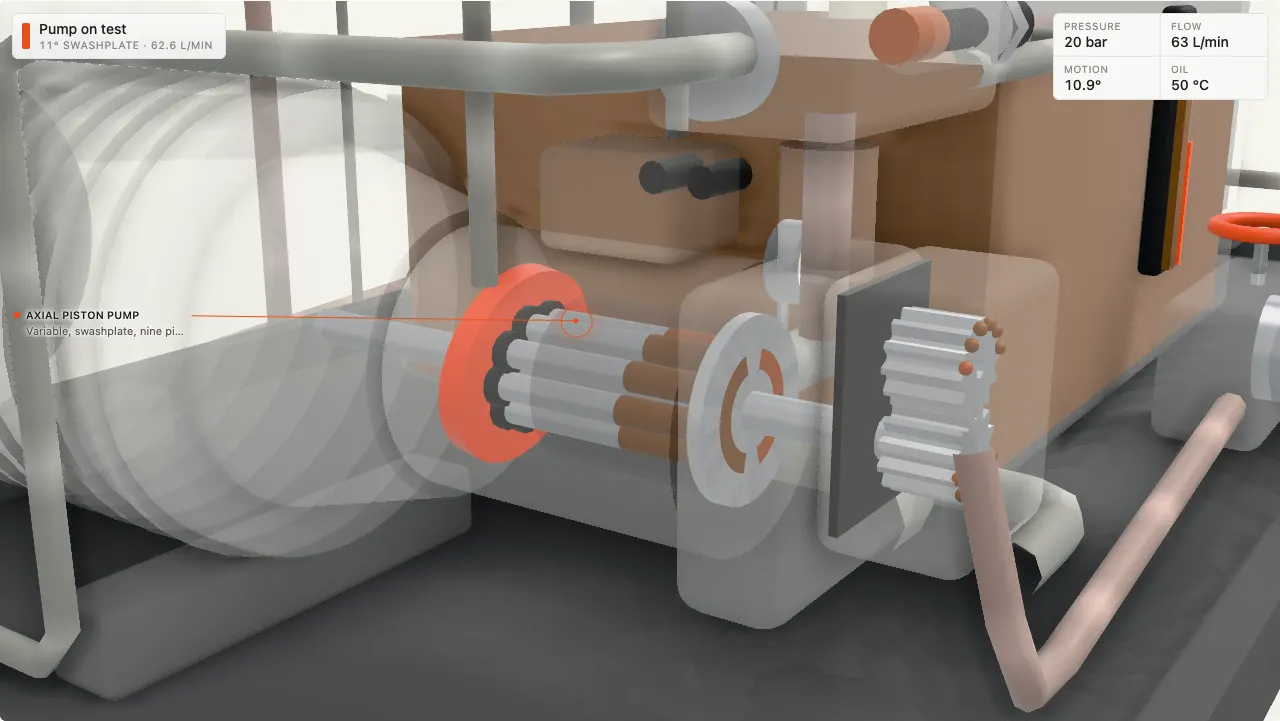
Variable piston pumps run most of the heavy hydraulics we see: offshore cranes, excavators, steering gear, hatch cover systems and large power packs. They make high pressure efficiently and, unlike a gear pump, they can change how much oil they deliver while turning at a constant speed. Tilt the swashplate in the animation and watch the pistons’ stroke change.
In simple terms
Inside the pump is a round block called the barrel, with nine holes bored along its length. Each hole has a piston in it. The barrel is turned by the drive shaft.
The feet of the pistons rest against a plate called the swashplate. If the swashplate is flat, square to the shaft, the pistons go round without moving in or out, and the pump delivers nothing, even though it is spinning.
Tilt the swashplate and everything changes. As the barrel turns, each piston’s foot slides round the tilted plate, so the piston is pulled out of its hole for half a turn (drawing oil in) and pushed back in for the other half (pushing oil out). The more you tilt, the longer each piston’s stroke, and the more oil per turn.
At the back of the barrel is the valve plate, which you can see end-on in the animation. It has two curved slots, called kidneys. Each piston’s hole passes over the suction kidney while it is filling, and over the delivery kidney while it is emptying. That is how oil is let in and pushed out without any valves opening and closing.
Some oil always leaks past the pistons and the valve plate. That is deliberate: it lubricates them. The leaked oil collects in the pump case and returns to the tank through a separate pipe, the case drain. As the pump wears, more oil leaks, and the case drain flow goes up. Measuring it is the quickest way to check a piston pump’s health.
- Play with it: Tilt the swashplate, change speed and pressure, and follow each piston round the valve plate.
- Break it: worn valve plate and slippers (case drain flow climbs) and a blocked case drain.
Sign in to read the rest of this lesson
Continue reading
Save your progress, open all 115 lessons and get a Course completed card when you finish.
or use your email
In the rest of this lesson
- Interactive animation: Swashplate axial piston pump
- For engineers
- Deep dive
- Key numbers
- 4 questions people ask
- Quiz: 4 questions
- Ask our engineers about this lesson
Familiarisation training from Al Safwan Academy. Finishing a course shows completion of online familiarisation training: it is not an STCW, flag-approved or manufacturer qualification, and these courses don't replace that training. The manufacturer's manual and your flag's rules always come first.