Lesson 1 · 6 min · Open to everyone
Pascal's law: how a small push lifts a heavy load
Pressure in a trapped liquid pushes equally on every surface it touches, so a small piston and a big piston share the same pressure, and the big one gets the bigger force.
Start here
The 2-minute primer
New to this? These 6 cards explain the lesson in plain words. Go through them first and the lesson will make sense.
Primer done.
-
1/6Picture this
A seesaw made of oil
On a seesaw, a small child sitting far from the middle can lift a grown-up sitting close to it. The child moves a long way down. The grown-up rises only a little.
A hydraulic jack does the same trick with oil instead of a plank. A long, easy push becomes a short, strong lift.
-
2/6The big idea
Push on oil and it pushes back everywhere
Oil hardly squashes at all. Push on it in a closed space and the pressure rises everywhere in it at once, by the same amount. That is Pascal’s law.
A small piston and a big piston share that same pressure. The big one has more area for the oil to push on, so it gets the bigger force.
-
3/6Words you'll meet
Five words, in plain English
- Pressure
- how hard the oil pushes on each square centimetre of the surface it touches.
- Piston
- a sliding plug inside a tube, pushed along by the oil or pushing on it.
- Area
- the size of the surface the oil pushes on. A wider piston has much more of it.
- Check valve
- a little one-way door that lets oil through in one direction only.
- Release valve
- the valve you open to let the oil back to the tank, so the load comes down.
-
4/6Why it matters
Strength comes with a catch
Hydraulics lets a pump the size of a shoebox lift a ship’s hatch cover. But nothing is free: to lift a load 1 mm, you may push 25 mm of oil.
The load is held up only by trapped oil. If a check valve or the release valve leaks, the load sinks slowly. That is why nobody should work under a load held only by hydraulics.
-
5/6In this lesson
What you’ll be able to do
- Explain why the same pressure gives a bigger force on a bigger piston.
- Work out how far the load rises for each push of the handle.
- Know what the two one-way valves inside a jack do.
- Spot why a jack sinks slowly after you stop pumping.
-
6/6Quick check
Two pistons share the oil. Which gets more force?
Right: the pressure is the same on both pistons, and the bigger one has more area for that pressure to push on.
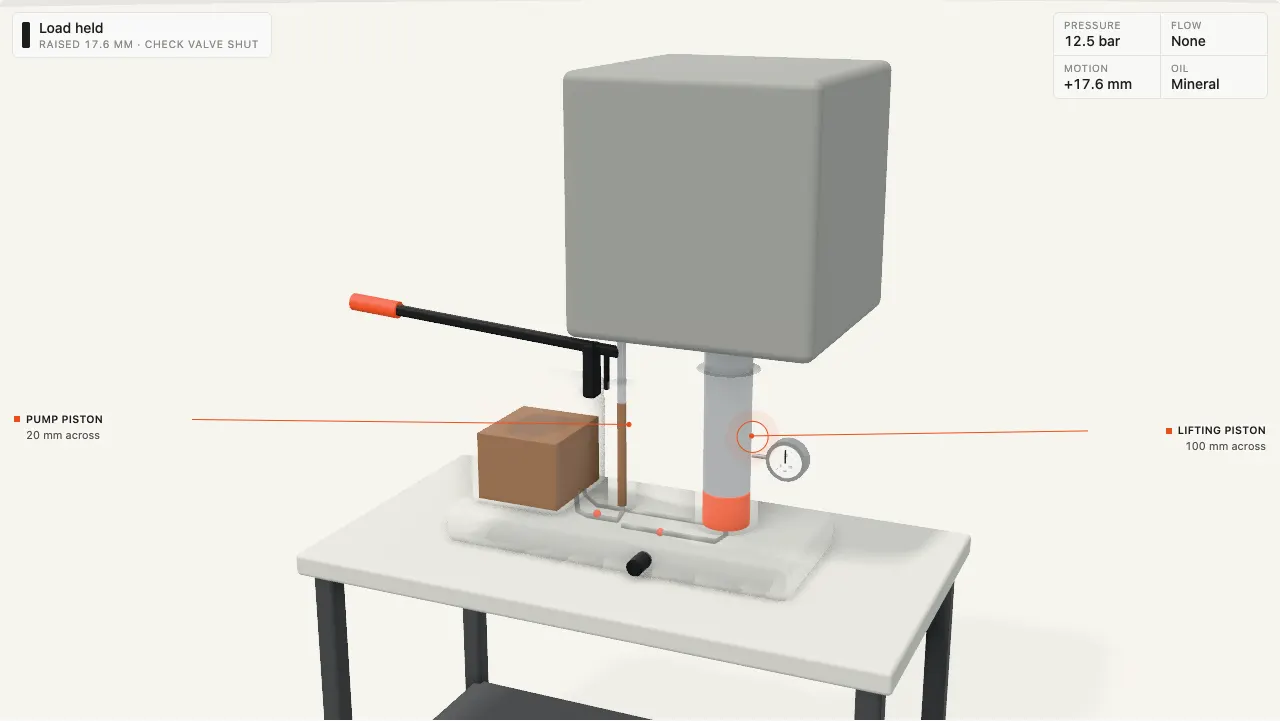
Push down on a liquid in a closed space and the pressure rises everywhere in it at once, by the same amount. That is Pascal’s law, and it is the whole reason hydraulics can lift a ship’s hatch cover with a pump the size of a shoebox. In the animation, drag the orange handle and watch the readouts: the pressure is the same in both cylinders, but the big piston has more area for it to push on.
In simple terms
Oil hardly squashes at all. When you push on it, it doesn’t get smaller, it moves somewhere else and pushes on whatever is in the way.
Pressure is how hard the oil pushes on each square centimetre of surface. If the small piston is 20 mm across and the big one is 100 mm across, the big piston has 25 times the area. The same pressure on 25 times the area gives 25 times the force. That’s how a 40 kg push holds up 1,000 kg.
There is a catch, and the animation shows it. To lift the load by 1 mm, you have to push 25 mm of oil out of the small cylinder. The force is multiplied, the distance is divided by the same number. No energy is created: a long, easy push becomes a short, strong lift.
A real jack does this in many small strokes. Two little one-way valves (check valves) make it work: one lets oil out of the small cylinder into the big one, the other lets the small cylinder refill from the reservoir when you lift the handle. Open the release valve and the oil flows back to the reservoir, so the load comes down under its own weight.
For engineers
Pressure is force divided by area:
| Quantity | Formula | Units used here |
|---|---|---|
| Pressure | p = F / A | N/mm² = MPa; 1 MPa = 10 bar |
| Force on a piston | F = p × A | bar ÷ 10 × mm² = N |
| Piston area | A = π d² / 4 | mm² from d in mm |
| Force ratio | F(big) / F(small) = A(big) / A(small) = (D / d)² | none |
| Travel ratio | s(big) / s(small) = A(small) / A(big) | none |
Worked example from the default setting: a 1,000 kg load weighs 9,810 N. On a 100 mm piston (7,854 mm²) that needs 1.25 N/mm², which is 12.5 bar. The 20 mm pump piston (314 mm²) needs the same 12.5 bar, so the push is 1.25 × 314 = 393 N, about 40 kg. A 110 mm stroke displaces 34.6 cm³, which lifts the big piston 4.4 mm.
Because force times distance is the same on both sides (ignoring friction), the work in equals the work out. Hydraulics is a lever made of oil: it doesn’t save energy, it lets you put the force exactly where you need it, through hoses, around corners, at any distance from the pump.
Two things this simple model leaves out, both covered in later lessons:
- Oil compresses slightly. Mineral oil shrinks about 0.7% per 100 bar, so at high pressure some of each stroke goes into squeezing the oil before the load moves. Trapped air makes this far worse, which is why a jack with air in it feels spongy.
- Seals and valves leak. Any leak path from the loaded side back to the reservoir lets the load sink. On a jack that is usually the outlet check valve or the release valve seat. On a machine it is the piston seal or a holding valve: see cylinder drift.
Deep dive
Pascal’s principle holds for a fluid at rest. In a working machine the oil moves, and some pressure is lost pushing it through hoses and valves, so the pressure at the pump is a little higher than at the cylinder. At jack speeds that loss is tiny, but in a crane circuit at 100 L/min it can be 10 to 20 bar.
The weight of the oil also adds pressure with depth (about 0.09 bar per metre for mineral oil). That is negligible next to 200 bar of working pressure, but it is why a pump’s suction inlet should sit below the tank’s oil level: a pump that has to lift its own oil starts to cavitate.
Where force multiplication turns up on real equipment:
- Hand pumps and bottle jacks, as in the animation. Workshop hand pumps for testing reach 700 bar with a pump piston of only a few millimetres.
- Hydraulic presses and pullers, where the big ram may be 200 to 300 mm across.
- Brakes on winches, cars and cranes: a small master cylinder drives bigger calipers.
- Every cylinder on a ship or crane. A luffing cylinder with a 200 mm bore at 250 bar pushes 785 kN, about 80 tonnes, from oil delivered through a hose the thickness of your thumb.
The check valves are where a jack fails. A seat worn by dirt, or a ball that can’t close because a particle is trapped under it, lets oil back. The symptom is exactly what the “Break it” switch shows: the load holds while you pump and creeps down while you rest. On a machine, the same job is done by pilot-operated check valves and counterbalance valves, which have their own lessons.
Key numbers
| What | Typical value |
|---|---|
| Pressure from a 1 t load on a 100 mm piston | 12.5 bar |
| Pressure in a workshop hand pump | up to 700 bar |
| Working pressure of deck cranes and steering gear | 150 to 250 bar |
| Force from a 200 mm cylinder at 250 bar | 785 kN (about 80 t) |
| Oil compressibility | about 0.7% volume per 100 bar |
Work out your own figures with the cylinder force and speed calculator on our sister site hydraulicsuae.com.
Related
Questions people ask
Does a bigger piston make more pressure?
No, the opposite. For the same load, a bigger piston needs less pressure because the weight is spread over more area. The pressure in a hydraulic system is set by the load and the area it acts on, never by the size of the piston alone.
Why does my jack sink slowly after I stop pumping?
Oil is getting back from the loaded side to the reservoir. On a jack, the usual causes are a dirty or worn outlet check valve or a release valve that doesn’t fully close. On a machine cylinder, look at the piston seal and any load-holding valves. Never work under a load held only by hydraulics.
Is hydraulic pressure the same everywhere in the system?
When the oil is still, yes, which is Pascal’s law. When oil is flowing, pressure drops along each hose and through each valve, so pressure at the pump is higher than at the cylinder. The difference is what drives the flow.
Why is oil used instead of water?
Oil lubricates the pump and valves, protects steel against rust, works over a wide temperature range and doesn’t boil at the temperatures a system reaches. Water-based fluids are used where fire is a risk, but they need special pumps and seals.
Check yourself
4 questions · pass with 60% to complete the lesson
Save your score and continue
An account keeps this result, opens lesson 2 and the rest of the course, and gives you a Course completed card when you finish.
or use your email
When you're done
Question about this lesson?
Ask our team
Stuck on something, or think a part could be clearer? Our engineers read every question and answer you by email. Only you and our team can see what you write.
Sign in to ask
or use your email
Familiarisation training from Al Safwan Academy. Finishing a course shows completion of online familiarisation training: it is not an STCW, flag-approved or manufacturer qualification, and these courses don't replace that training. The manufacturer's manual and your flag's rules always come first.