Lesson 16 · 7 min
Load sensing explained: one job, three pumps, and where the power goes
A load-sensing pump reads the pressure the load needs and makes only a small margin more, delivering only the flow the valve asks for. The same job that wastes most of a fixed pump's power wastes almost nothing.
Start here
The 2-minute primer
New to this? These 6 cards explain the lesson in plain words. Go through them first and the lesson will make sense.
Primer done.
-
1/6Picture this
Driving with one foot on the brake
Imagine driving with the accelerator pressed flat to the floor all the time, and controlling your speed only with the brake. You’d get there, but the brakes would glow hot and the fuel would vanish.
A simple hydraulic pump often works like that. A load-sensing pump presses the accelerator only as far as the road needs.
-
2/6The big idea
Make only what the job needs
Every hydraulic job needs enough pressure to move the load and enough flow to move it at the right speed. Anything the pump makes beyond that turns into heat.
A fixed pump always gives full flow and full pressure. A load-sensing pump reads the pressure the load needs, makes a little more, and gives only the flow the valve asks for.
-
3/6Words you'll meet
Five words, in plain English
- Fixed pump
- a pump that always delivers the same amount of oil, whether it is needed or not.
- Pressure-compensated pump
- a pump that turns its flow down, but always holds its full set pressure.
- Load-sensing pump
- a pump that makes only the pressure the load needs, plus a small margin.
- Load-sense line
- a small pipe that carries the load’s pressure back to the pump, so it knows what to make.
- Margin
- the small extra pressure the pump keeps above the load, usually about 20 bar.
-
4/6Why it matters
Wasted power ends up as heat
On the same job, a fixed pump can waste most of its power as heat, while a load-sensing pump wastes very little. In hot weather that is the difference between a calm machine and one that overheats all summer.
If the load-sense line gets blocked, the pump never hears what the load needs, and the machine goes weak even though the pump is fine.
-
5/6In this lesson
What you’ll be able to do
- Compare a fixed, a pressure-compensated and a load-sensing pump on one job.
- See where each one wastes power.
- Know what the margin does, and why turning it up makes heat.
- Spot a blocked load-sense line.
-
6/6Quick check
What does a load-sensing pump do differently?
Right: it follows the load’s pressure plus a small margin and gives only the flow asked for, so very little power turns into heat.
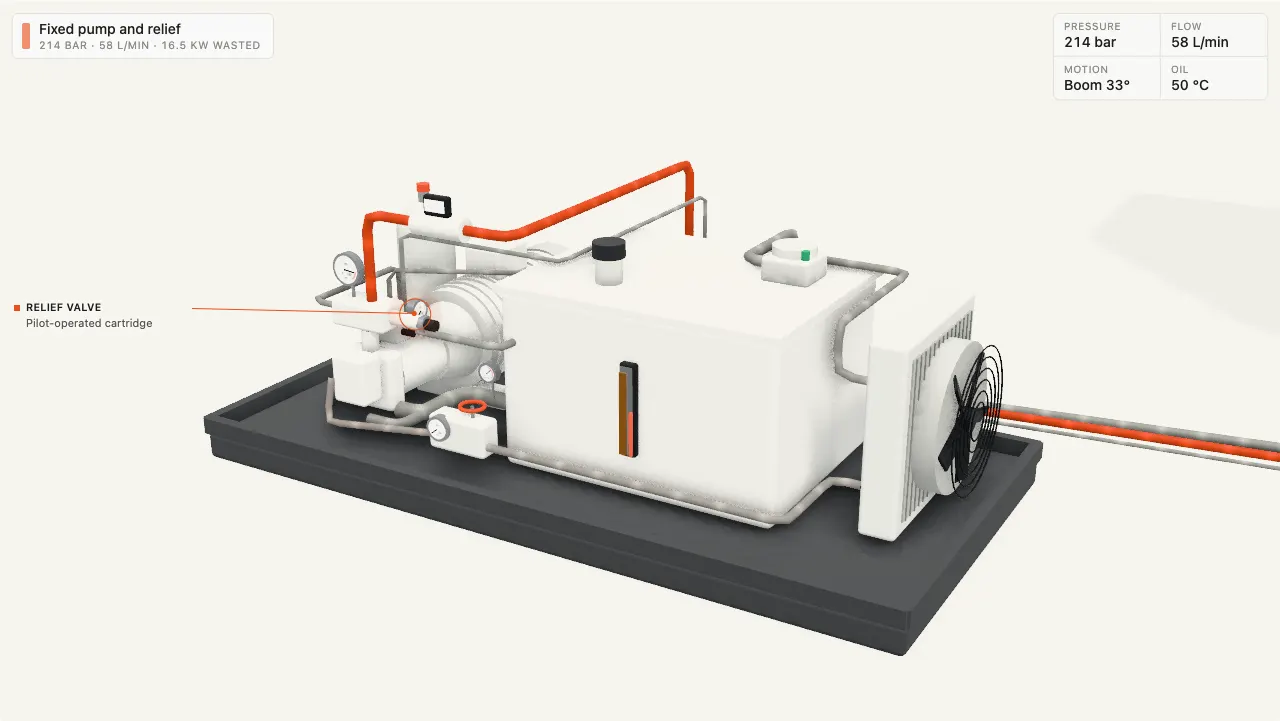
Most hydraulic heat is made on purpose, by the way the system is designed. A fixed pump pushing a small job through a valve can turn four fifths of its input power into heat. A load-sensing pump doing the same job wastes a fraction of that. This lesson puts the three common designs side by side on one job. Move the sliders and watch the bars on the right.
In simple terms
Every hydraulic job needs two things: enough pressure to move the load, and enough flow to move it at the right speed. The job in the animation needs 120 bar and 20 litres a minute. Anything the pump makes beyond that is turned into heat.
Fixed pump and relief valve. The pump always delivers its full 60 litres a minute. The job only takes 20, so the other 40 must go somewhere: over the relief valve, at full relief pressure. And because the pump is at relief pressure, the control valve has to throttle the oil down from 210 bar to the 120 the load needs. Both losses are heat. Only about a fifth of the power does useful work.
Pressure-compensated pump. This pump turns itself down to deliver only the flow the system takes, so nothing goes over the relief. But it still holds its full set pressure, 210 bar, all the time, and the valve still has to burn the difference down to 120 bar. Better, but still wasteful when the load needs much less than full pressure.
Load-sensing pump. A small pipe, the load-sense line, carries the load’s pressure back to the pump. The pump makes that pressure plus a small margin, usually about 20 bar, and only the flow the valve lets through. For our job: 140 bar and 20 litres a minute. The only loss is the 20 bar margin across the valve.
When the load-sense line is blocked, the pump never hears what the load needs. It sits at its low standby pressure and the machine “goes weak”, even though the pump itself is fine.
- Play with it: Switch between three pump systems doing the same job and compare useful and wasted power.
- Break it: a blocked load-sense line (the machine goes weak) and a margin set too low or too high.
Sign in to read the rest of this lesson
Continue reading
Save your progress, open all 115 lessons and get a Course completed card when you finish.
or use your email
In the rest of this lesson
- Interactive animation: Fixed, pressure-compensated and load-sensing supply
- For engineers
- Deep dive
- Key numbers
- 4 questions people ask
- Quiz: 4 questions
- Ask our engineers about this lesson
Familiarisation training from Al Safwan Academy. Finishing a course shows completion of online familiarisation training: it is not an STCW, flag-approved or manufacturer qualification, and these courses don't replace that training. The manufacturer's manual and your flag's rules always come first.