Lesson 20 · 8 min
How a hydraulic crane circuit works: slew, luff and hoist from one pump
One pump feeds a valve bank with a section for each movement. Run two at once and the oil goes to whichever needs the least pressure, so the crane's behaviour depends as much on the circuit as on the load.
Start here
The 2-minute primer
New to this? These 6 cards explain the lesson in plain words. Go through them first and the lesson will make sense.
Primer done.
-
1/6Picture this
One water supply, two taps
In some houses, someone turns on the kitchen tap downstairs and the shower upstairs drops to a trickle. The water takes the easy way out through the low tap before it bothers climbing the stairs.
Oil from a crane’s single pump behaves like that crowd. It always takes the easiest path.
-
2/6The big idea
One pump, three movements, one share
A deck crane has three movements, each with its own lever. All three are fed by one pump. Move one lever and it gets all the oil it can use.
Move two together and the oil goes first to the one that needs the least pressure. The harder one slows down or stops. Valves and a brake hold the load when the levers are let go.
-
3/6Words you'll meet
Five words, in plain English
- Slewing
- turning the whole crane round on its pedestal.
- Luffing
- raising and lowering the crane’s boom.
- Hoisting
- winding the wire in or out to lift and lower the hook.
- Valve bank
- a block of control valves, one section for each movement, each worked by its own lever.
- Safe working load
- the heaviest load the crane is allowed to lift in normal work.
-
4/6Why it matters
Behaviour that looks like a fault
“The crane won’t hoist while I slew” is usually the circuit working as built, not a broken part. Knowing that saves needless repairs.
A real fault is different. A leaking valve or slipping brake lets the boom or load creep down, and a blocked filter sends dirty oil round. After any repair to the lifting parts, the crane needs a load test.
-
5/6In this lesson
What you’ll be able to do
- Name the three crane movements and what drives each one.
- Explain how one pump shares its oil between them.
- Know what holds the boom and the hook when the levers are let go.
- Spot a leaking counterbalance valve, a worn motor and a slipping brake.
-
6/6Quick check
Two levers at once. Which movement gets oil first?
Right: oil takes the easiest path, so the movement needing the least pressure is fed first and the harder one waits.
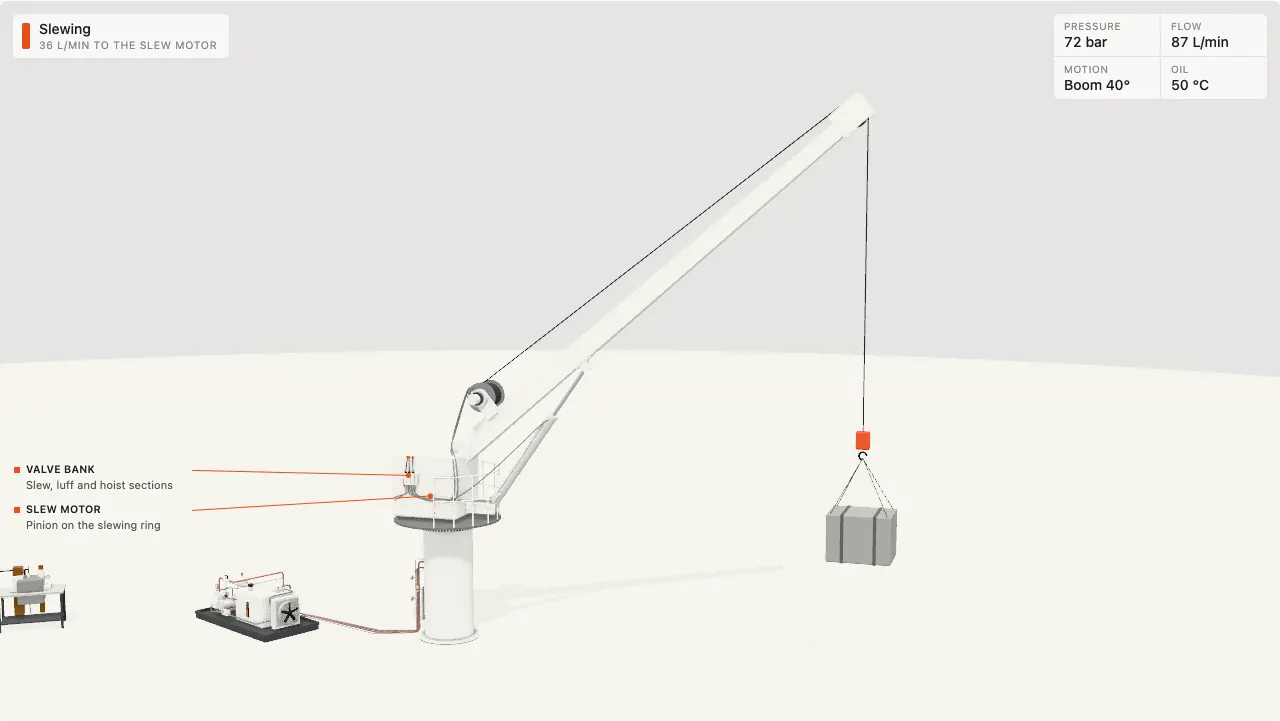
A ship’s provision crane brings together almost everything in the earlier lessons: a pump and relief valve, directional valves, a cylinder held by a counterbalance valve, a winch motor with a brake, and a filter keeping the oil clean. In the animation, move two or three levers at once and watch where the oil goes. Then load the hook past its safe working load, and try the faults.
In simple terms
A deck crane has three movements. Slewing turns the whole crane round on its pedestal. Luffing raises and lowers the boom. Hoisting winds the wire in or out to lift and lower the hook. Each one has its own section in the valve bank, worked by its own lever.
All three are fed by one pump. That is fine when only one lever is moved: that movement gets all the oil it can use. When two are moved together, the oil does what water does: it takes the easiest path. The movement that needs the least pressure gets its oil first, and the harder one waits. In the animation, hoist and luff together with a few tonnes on the hook: one of them slows down or stops. Operators know this as “the crane won’t hoist while I slew”.
The heavier the load and the further out the boom, the more pressure luffing needs. If it needs more than the relief valve allows, the boom simply won’t go up. That’s not a safe overload system (modern cranes have proper load limiters), but it shows why a crane that has “lost power” usually has a pressure problem.
Two things hold the load when the levers are in the middle. A counterbalance valve on the luff cylinder traps the oil under the piston, so the boom can’t fall. A spring-applied brake on the winch holds the hook, and only releases when oil pressure pushes it off. If either leaks or slips, the boom or the load creeps down.
- Play with it: Slew, luff and hoist at once, change the hook load and pump flow, and watch one pump share its oil.
- Break it: a leaking counterbalance valve, a worn hoist motor, a slipping winch brake and a clogged return filter.
Sign in to read the rest of this lesson
Continue reading
Save your progress, open all 115 lessons and get a Course completed card when you finish.
or use your email
In the rest of this lesson
- Interactive animation: Provision crane: slew, luff and hoist on one pump
- For engineers
- Deep dive
- Key numbers
- 4 questions people ask
- Quiz: 4 questions
- Ask our engineers about this lesson
Familiarisation training from Al Safwan Academy. Finishing a course shows completion of online familiarisation training: it is not an STCW, flag-approved or manufacturer qualification, and these courses don't replace that training. The manufacturer's manual and your flag's rules always come first.