Lesson 9 · 6 min
How a directional control valve works: spools, ports and centre types
A directional valve is a precision spool sliding in a bore. Its lands open and close passages between the pump, the tank and the two sides of a cylinder; the shape of the lands in the middle position decides what the machine does when you let go.
Start here
The 2-minute primer
New to this? These 6 cards explain the lesson in plain words. Go through them first and the lesson will make sense.
Primer done.
-
1/6Picture this
Railway points for oil
At a railway junction, the points slide across to send a train down one track or the other. Nothing about the train changes, only where it goes.
A directional control valve does this for oil. Move the lever one way and oil goes to one side of the cylinder. Move it the other way and the paths swap.
-
2/6The big idea
What happens when you let go
Inside the valve, a precision steel spool slides in a bore. Raised rings on it, called lands, open some passages and close others.
When you let go of the lever, springs push the spool back to the middle. What the middle does is a design choice: hold the load, let the pump rest, or let everything move freely.
-
3/6Words you'll meet
Five words, in plain English
- Spool
- a precision steel rod sliding inside the valve body that opens and closes the oil paths.
- Land
- a raised ring on the spool that covers or uncovers a groove in the bore.
- Port
- a connection on the valve: P for the pump, T for the tank, A and B for the cylinder.
- Centre type
- what the valve connects in its middle position: closed, tandem, open or float.
- Tandem centre
- a middle position that sends the pump’s oil to the tank and holds the cylinder still.
-
4/6Why it matters
A spool always leaks a little
A spool needs a tiny gap to slide, so it can never seal perfectly. Wear and hot oil let more slip past, and the load creeps down in neutral.
A spool can also stick from dirt or varnish. On a crane, a function that keeps moving after the operator lets go means the machine must be taken out of service.
-
5/6In this lesson
What you’ll be able to do
- Follow how the spool’s lands steer oil between pump, tank and cylinder.
- Tell the four centre types apart and when each one is used.
- Match the valve’s symbol to what the spool is doing.
- Spot the signs of a worn or sticking spool.
-
6/6Quick check
With a tandem centre in neutral, where does the pump’s oil go?
Right: a tandem centre joins the pump to the tank and blocks the cylinder, so the pump rests at low pressure while the load holds.
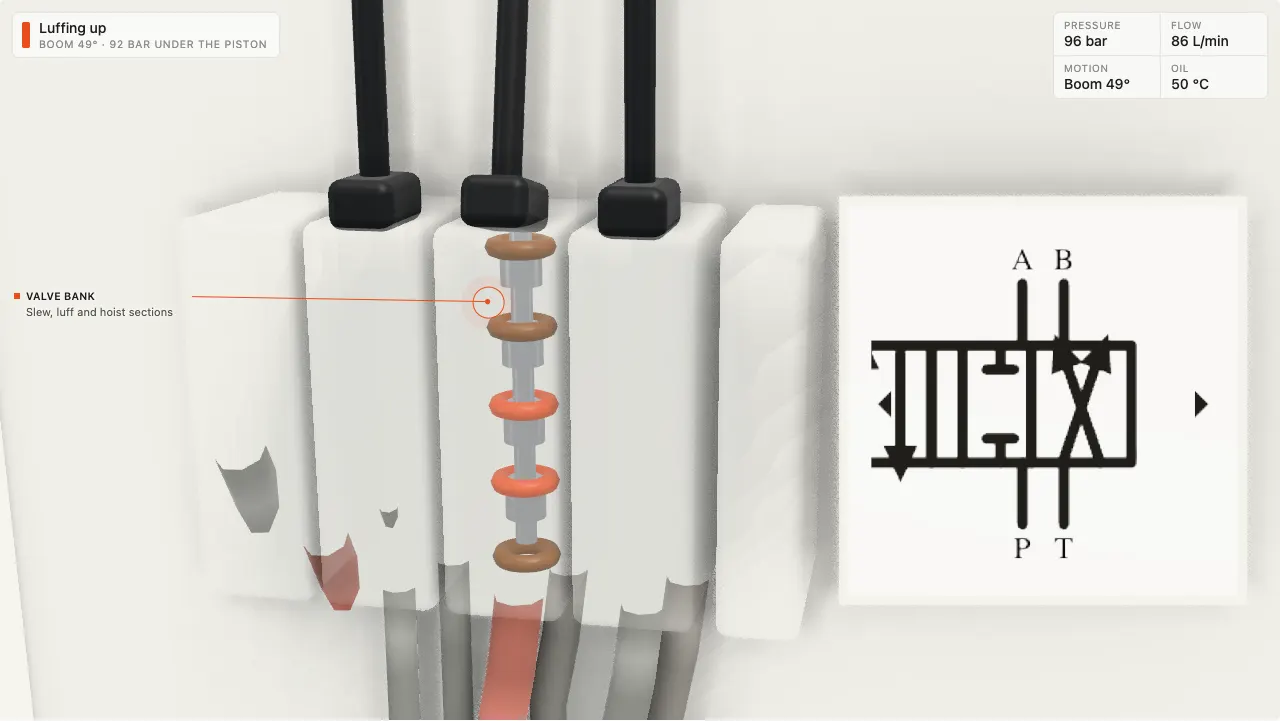
The directional control valve is the steering wheel of a hydraulic machine. On a crane it’s the bank of levers in the cab, on a winch the joystick on deck, on a press the solenoid valve on the power pack. Inside each section is a steel spool, ground to a few thousandths of a millimetre, sliding in a bore. Move the lever in the animation and watch how the spool’s lands open one path and close another, and how the symbol above changes with it.
In simple terms
The valve body has five grooves cut around its bore: one for the pump (P), two for the tank (T) and one each for the two sides of the cylinder (A and B). The spool has raised rings, called lands, that slide over those grooves and cover or uncover them.
Push the lever one way and the spool moves so that pump oil can reach one side of the cylinder while the other side drains to tank. Push it the other way and the paths swap. Let go, and springs push the spool back to the middle.
What happens in the middle is a design choice, and it is the most useful thing to understand about any valve:
- Closed centre: everything is blocked. The cylinder holds, but the pump’s oil has nowhere to go and dumps over the relief valve as heat, unless the pump can turn itself down.
- Tandem centre: the pump is connected to tank, the cylinder ports are blocked. The pump rests at low pressure and the cylinder holds. This is the common choice for a fixed pump.
- Open centre: everything is connected. The pump unloads and the cylinder is free to move. Good for a motor that should coast to a stop.
- Float centre: the pump is blocked, both cylinder ports go to tank. Used where a blade or a roller should follow the ground, and with pilot-operated checks and counterbalance valves, which need their pilot lines vented in neutral.
Try each with the load hanging on the cylinder.
- Play with it: Move the lever, change the centre type, and watch the spool and the ISO symbol move together.
- Break it: a worn spool that lets the load creep (worse when hot) and a sticking spool.
Sign in to read the rest of this lesson
Continue reading
Save your progress, open all 115 lessons and get a Course completed card when you finish.
or use your email
In the rest of this lesson
- Interactive animation: Spool valve cutaway with its ISO symbol
- For engineers
- Deep dive
- Key numbers
- 4 questions people ask
- Quiz: 4 questions
- Ask our engineers about this lesson
Familiarisation training from Al Safwan Academy. Finishing a course shows completion of online familiarisation training: it is not an STCW, flag-approved or manufacturer qualification, and these courses don't replace that training. The manufacturer's manual and your flag's rules always come first.