Lesson 3 · 7 min
The basic hydraulic circuit: pump, relief valve, control valve and cylinder
The pump makes flow, the load makes pressure, the relief valve sets the limit and the control valve decides where the oil goes. Every hydraulic machine is built on these four parts.
Start here
The 2-minute primer
New to this? These 6 cards explain the lesson in plain words. Go through them first and the lesson will make sense.
Primer done.
-
1/6Picture this
A home heating system, four jobs
In a home central heating system, a pump pushes water round the pipes. A small safety valve lets some out if the pressure climbs too high. Valves decide which radiator gets the hot water.
A hydraulic machine is built the same way. One part pushes, one part guards, one part steers and one part does the work.
-
2/6The big idea
Four parts doing four jobs
Almost every hydraulic machine, from a provision crane to a factory press, is the same four parts. A pump pushes oil. A relief valve stops the pressure going too high. A control valve sends the oil one way or the other. A cylinder turns it back into movement.
Learn these four and most machines start to make sense.
-
3/6Words you'll meet
Five words, in plain English
- Pump
- the part, turned by a motor, that pushes out the same amount of oil every turn.
- Relief valve
- the safety limit. It opens and dumps oil back to the tank when pressure gets too high.
- Control valve
- the lever-worked valve that sends oil to raise, hold or lower the load.
- Cylinder
- a tube with a piston and rod inside that turns oil pressure into a straight push.
- Piston seal
- the ring around the piston that stops oil slipping from one side to the other.
-
4/6Why it matters
Slow, hot or drifting always has a cause
Oil pushed over the relief valve does no work and turns into heat. An operator holding the lever at the end of the stroke is quietly cooking the oil.
Worn parts show up too. A worn piston seal lets the load creep down in Hold. A worn pump makes the machine slow and hot when it works hard.
-
5/6In this lesson
What you’ll be able to do
- Name the four main parts and the job each one does.
- Tell what the load changes and what the pump flow changes.
- See where the oil goes when the cylinder reaches the end of its stroke.
- Tell a worn piston seal from a worn pump by the symptoms.
-
6/6Quick check
In Hold, the load slowly sinks. What is worn?
Right: in Hold the pump isn’t connected to the cylinder, so oil slipping past a worn piston seal is what lets the load creep down.
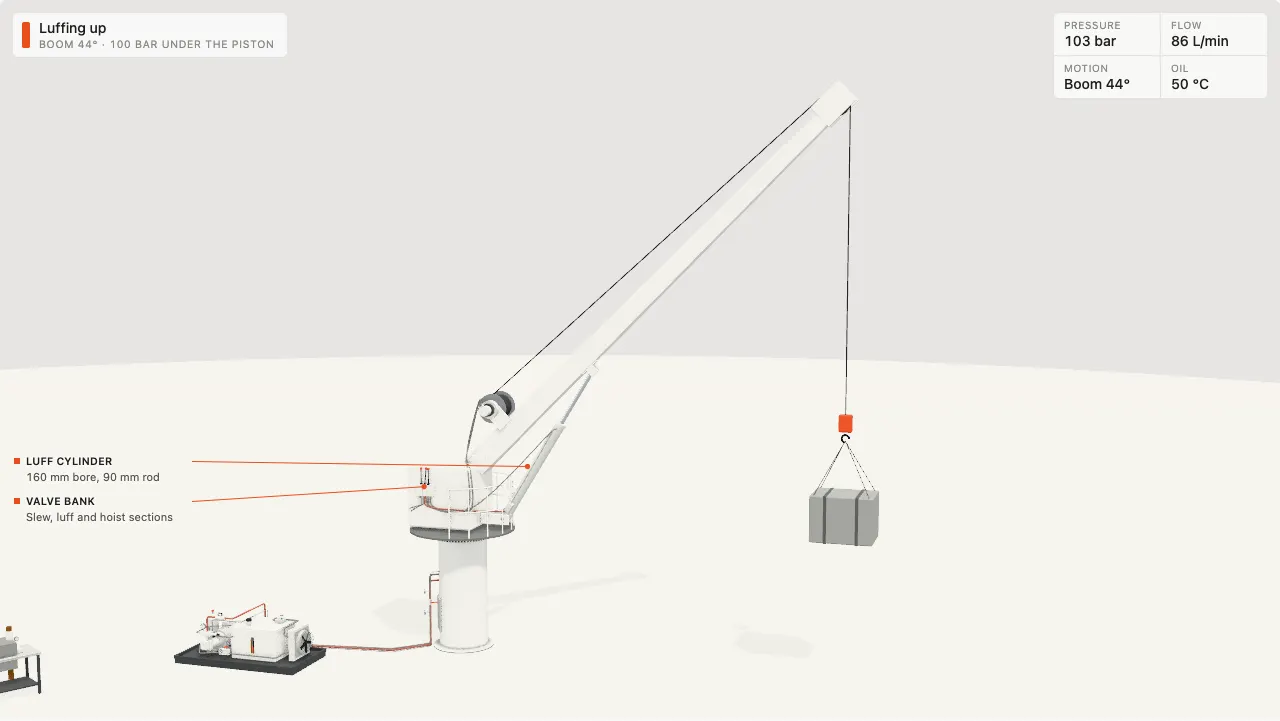
Almost every hydraulic machine, from a provision crane to a factory press, is the same four parts doing the same four jobs. A pump pushes oil. A relief valve stops the pressure going too high. A control valve sends the oil one way or the other. A cylinder or motor turns it back into movement. Play with the lever and the sliders above, then tick a fault and watch what changes.
In simple terms
The pump makes flow, not pressure. An electric motor turns the pump, and every turn pushes out the same amount of oil. More flow means the cylinder moves faster.
The load makes the pressure. Oil only gets pushed as hard as it has to be to move what’s in the way. Lift a light load and the gauge reads low. Lift a heavy one and it reads high. Try it: change the load and watch the gauge, then change the pump flow and watch the speed. Each slider moves a different readout.
The relief valve is the safety limit. If the load needs more pressure than the relief valve allows, the valve opens and dumps the oil back to the tank. The machine stops moving, but nothing bursts. The cost is heat: all that oil is being forced through a small gap at full pressure, and that energy warms the oil. Hold the lever at the end of the stroke and watch the “heat” readout.
The control valve is the driver. Raise sends oil under the piston. Hold traps the oil in the cylinder so the load stays put, and lets the pump’s oil go straight back to the tank at low pressure. Lower sends oil above the piston and lets the oil underneath return to the tank.
The faults show two problems we see every week. A worn piston seal lets oil slip past inside the cylinder, so the load creeps down even with the valve in Hold. A worn pump leaks inside, so at high pressure it delivers less oil than it should and the machine gets slow and hot.
- Play with it: Lever, load, pump flow and relief setting, with a live gauge and the heat being made.
- Break it: a worn piston seal (the load drifts) and a worn pump (the lift slows).
Sign in to read the rest of this lesson
Continue reading
Save your progress, open all 115 lessons and get a Course completed card when you finish.
or use your email
In the rest of this lesson
- Interactive animation: Pump, relief, control valve, cylinder
- For engineers
- Deep dive
- Key numbers
- 4 questions people ask
- Quiz: 4 questions
- Ask our engineers about this lesson
Familiarisation training from Al Safwan Academy. Finishing a course shows completion of online familiarisation training: it is not an STCW, flag-approved or manufacturer qualification, and these courses don't replace that training. The manufacturer's manual and your flag's rules always come first.